What on Earth happened to union organizer Fannie Sellins?

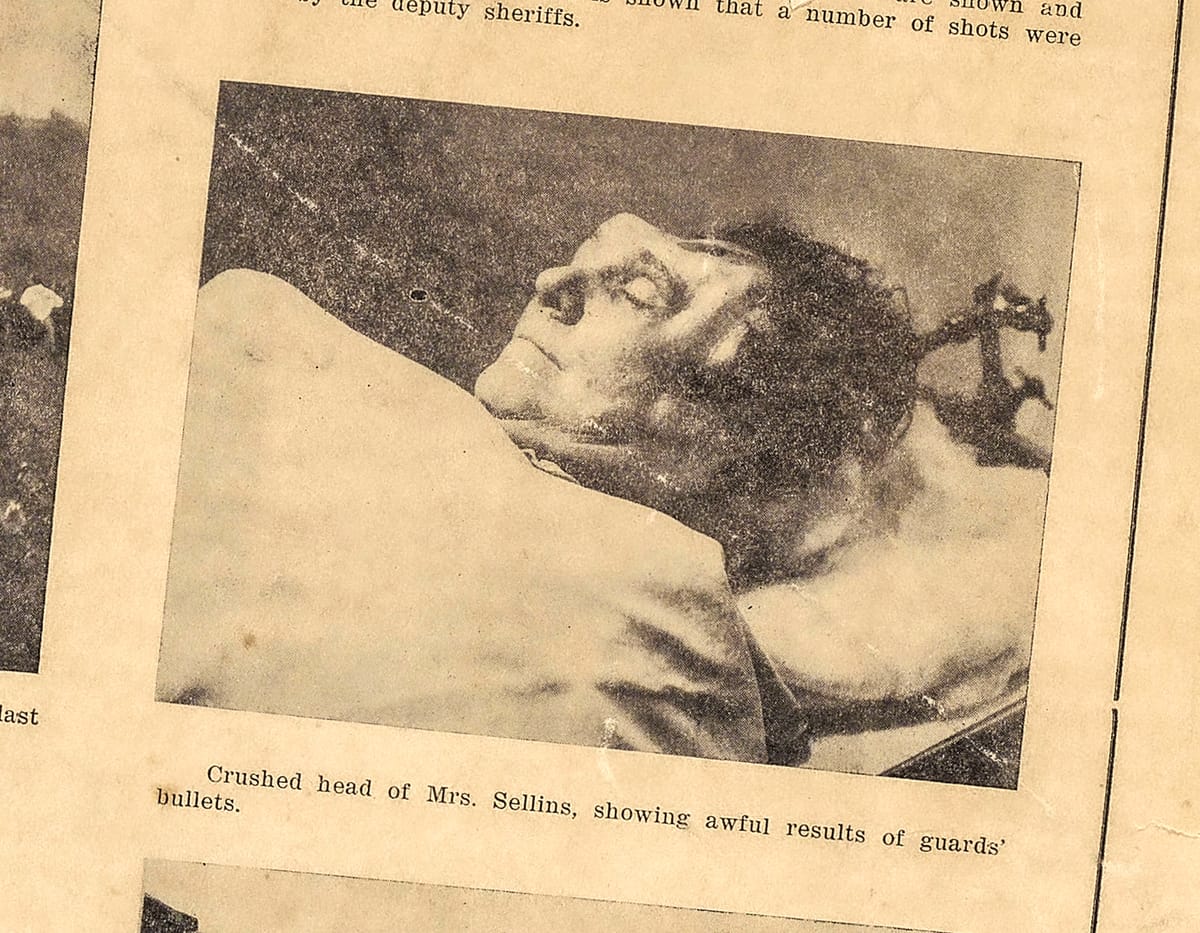
If you look only at the closed eyes and the serene expression on the woman’s face you would think perhaps she is simply sleeping. But you can’t ignore the forehead, the way it collapses inward just above the eyebrows. The question that arises: Is this grotesque evidence of a horrific injury? Just below the hairline is a dark wound the size of walnut. Who is this person? And what happened to her?
The picture appeared in a broadside paper published more than a century ago by the United Mine Workers of America. It was pressed into buttons worn by steelworkers seeking motivation to continue a difficult strike. Union organizers tacked postcard-sized prints to their bulletin boards.
Today the picture is mostly forgotten, but it retains its power as a stark reminder of the tactics officials were willing to employ to ensure working people kept their mouths shut and put up with whatever conditions big business interests and their government supporters imposed upon them. This proved especially true if those workers happen to be born in countries other than the United States.
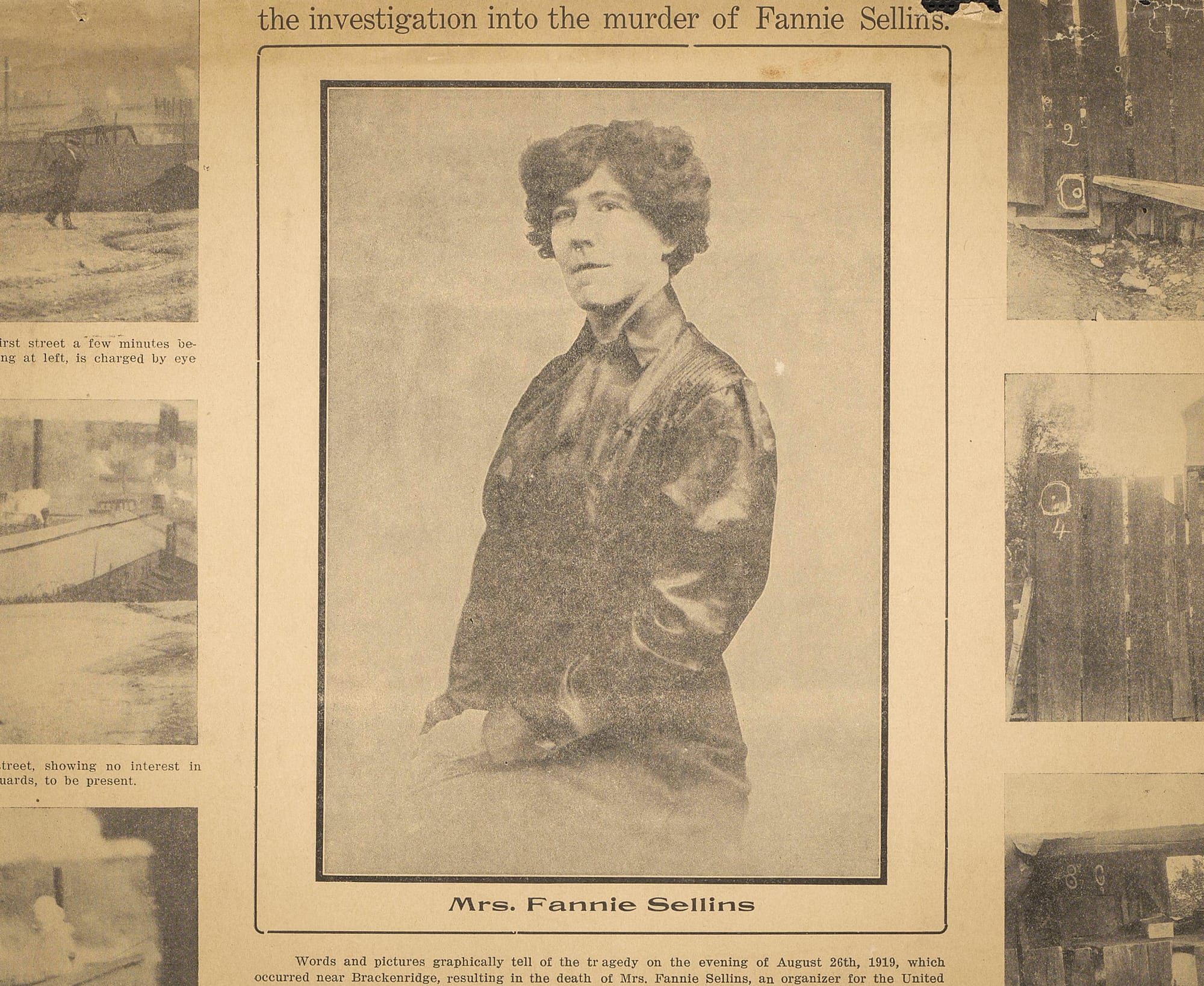
The woman in the picture is Fannie Sellins, a union organizer who arrived in the Pittsburgh region 110 years ago. Three years later, in the summer of 1919, as labor tensions rose throughout the country, Sellins placed herself in the midst of a contentious strike in the Allegheny Valley, a region so ferociously anti-union that organizers called it Black Valley. In August 1919, Sellins would pay a great price for her tenacity and courage.
Tensions between workers and their bosses in the Pittsburgh region had been rising for months. During a world war that only recently ended, steel and other industries had made huge fortunes while workers made sacrifices on behalf of their country. Now workers wanted long delayed higher wages and shorter shifts. Company owners balked. They wanted to keep their money.
Pittsburgh seemed explosive. So did steel towns in the Monongahela Valley, southwest of the city, as well as the Allegheny Valley. Angry workers rallied and talked of strikes. The labor movement began flexing its power in summer 1919, and it was freaking out a lot of powerful people. Allegheny County Sheriff William Haddock responded by deputizing hundreds of men to keep workers in line. Haddock’s new men, some recruited from taverns, were poorly trained, but that seemed to matter little. They were adequate as a force of intimidation and violence on behalf of the region’s business interests.
August 1919 brought tumultuous change to the Pittsburgh region. On Aug. 11, The Pittsburgh Press greeted its afternoon readers with a bold-type headline, “Andrew Carnegie Dead.” Carnegie had condemned his workers to bleak and exhausting lives in order to create the world’s most profitable steel company. In 1901 he sold Carnegie Steel to financier J.P. Morgan for $480 million, thus becoming the world’s richest man. By then, he’d set an enduring pattern in the industry.
Nearly two decades later, steelworkers were still pulling brutal 12-hour shifts at difficult, dangerous jobs that left them physically broken. Carnegie’s death at 83 seemed a symbolic confirmation that it was time to end the status quo. The nation’s steelworkers were threatening a strike, demanding an end to the system of wages and hours Carnegie had helped engineer decades earlier.
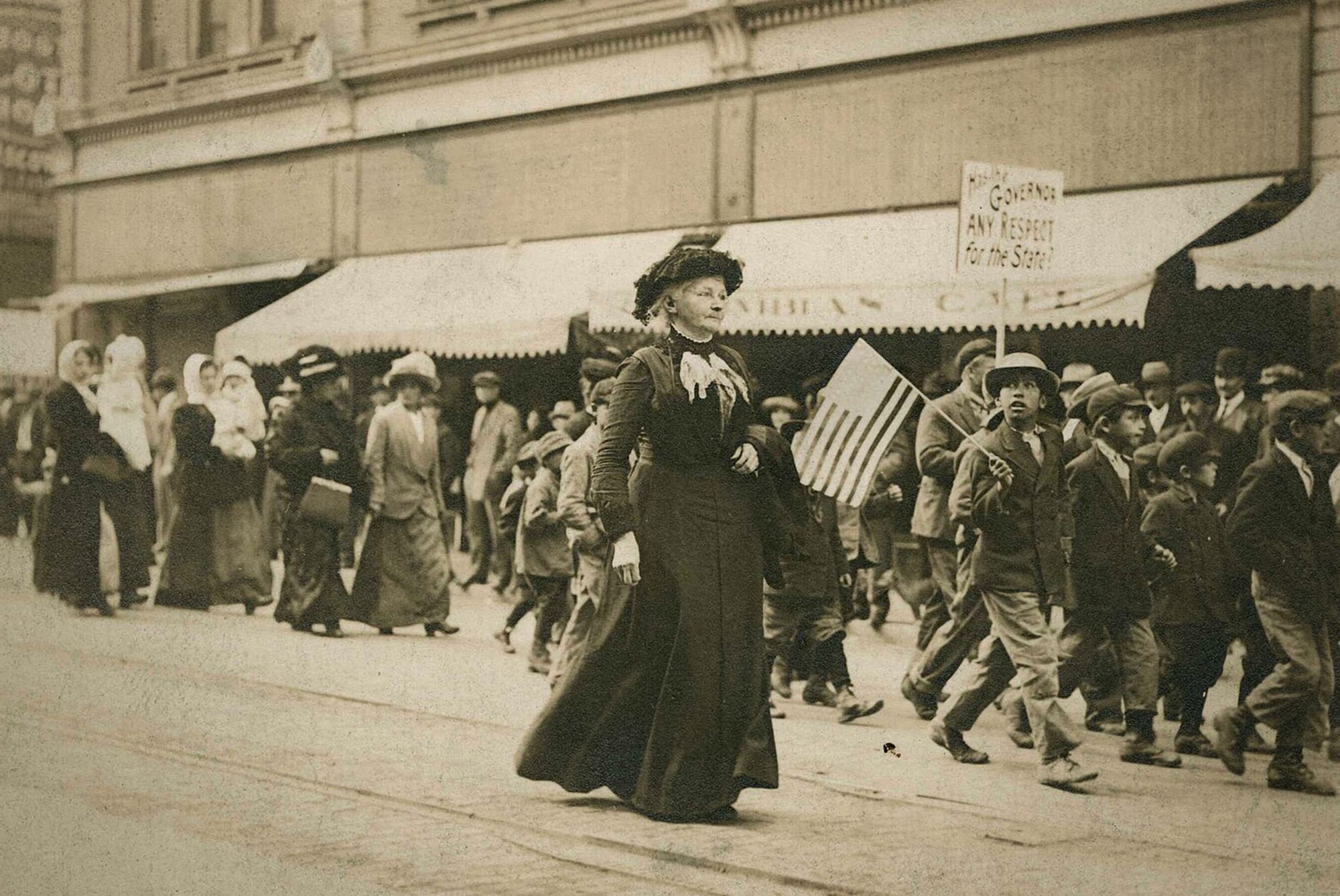
One day before Carnegie drew his last labored breath, one of his peers in age, 82-year-old Mother Jones, stood before 1,500 mill workers and their families in Clairton and drew applause by declaring the 20th century would be the people’s century.
Despite her age, Jones remained defiant as ever. She was a legend among working people for her efforts as a union organizer, especially among Appalachian coal miners. Her sharp tongue and fearlessness alarmed others. Government officials considered her the “most dangerous woman in America.”
In Clairton, for example, she took on the class division keeping workers from unifying. “There are no foreigners in America,” she proclaimed. Slavic people had been pouring into the region to do the dirty, dangerous work of making steel. These new arrivals spoke strange languages and ate strange food. Plus they were building Catholic churches all over the place.
None of this bothered Jones, and she let it be known that it shouldn’t bother other workers. “As soon as an immigrant enters America’s gate, that day he becomes an American citizen,” she said. “We all belong to Uncle Sam.”
Jones traveled to Pittsburgh’s South Side on Aug. 14, and delivered a rousing speech to 3,000 steelworkers at the Polish Falcon Hall on South 18th Street. Pittsburgh police stood by, thinking the crowd might get out of hand. It didn’t. The city and region would not explode that day, but a fuse was definitely burning. More than one in fact.
That same day more than 1,500 unionized conductors and motormen of the Pittsburgh Railways Co. crowded into the Union Labor Temple in Pittsburgh’s Lower Hill, a mile from where Jones was addressing steelworkers. The streetcar employees, members of Amalgamated Association of Street and Electric Railways Employees of America, were fed up with low pay. They demanded a 12-cent an hour wage increase to match what their counterparts were making in other major cities. Company officials said no. When leaders in the temple called for a voice vote on a strike, people standing a block away could hear the collective response echoing down the street: “Aye!”
The situation was equally explosive in the Allegheny Valley, 20 miles northeast of Pittsburgh.
Sellins stepped into this region in 1916 to organize miners for the United Mine Workers of America. At 48, Sellins was younger and less of a firebrand than Jones, but she proved an effective organizer of garment workers in St. Louis and coal miners in West Virginia. By July 1919, she was working a strike of coal miners employed by Allegheny Coal and Coke in the small community of Natrona. Workers there were tired of earning 63 cents per hour less than their counterparts in Pittsburgh while working two hours longer each day.
Sellins also helped organize steelworkers gearing up for a strike that seemed inevitable. She knew the fate of those who dug coal from the earth was linked to that of workers who used that coal to forge steel.
Officials were having none of it. They unleashed sheriff’s deputies and state police troopers on the workers and turned the Allegheny Valley into a police state. Haddock declared meetings of three or more people to be illegal. Mounted state troopers harassed people on streets and sidewalks. Stopping to speak with a friend proved risky. Police attended public meetings to make sure everyone spoke English and to pull the plug on speakers who strayed into “unauthorized” topics.
As an organizer, Sellins became a target. On one occasion, she barked “scab” at a deputy arresting her.
Incensed, the deputy declared he’d get revenge on that “goddamn whore son of a bitch.”
In Pittsburgh, no streetcars moved once the strike began at midnight on Aug. 15. People walked to work, or they rode bicycles or hired jitneys or taxis. By Aug. 25, managers at the Pittsburgh Railways Co. determined enough was enough. They decided to employ 300 scabs to operate their streetcars on a limited basis.
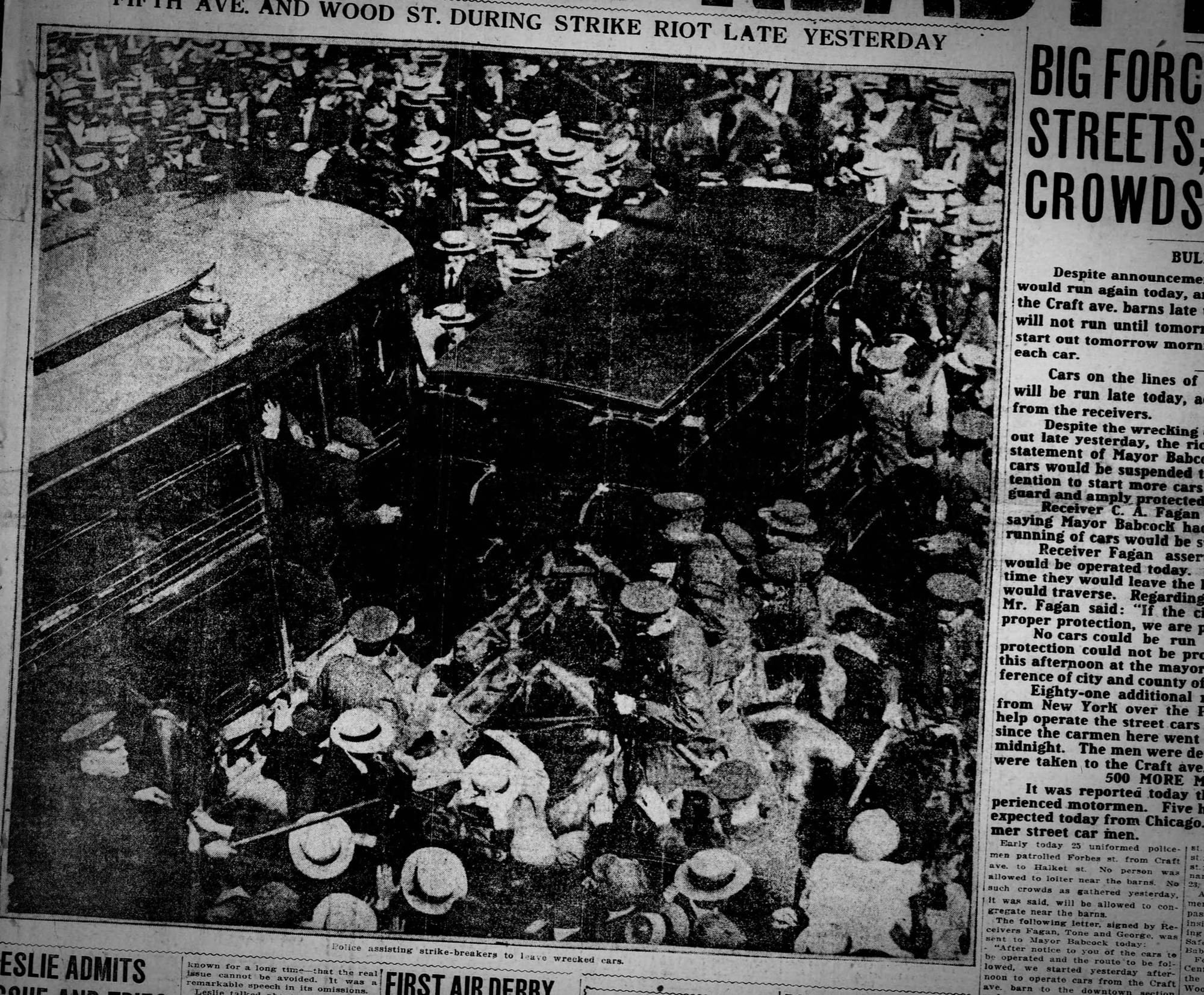
Union workers learned of the company’s plans, and a crowd of about 1,000 gathered at the Craft Avenue car barn in Oakland. At 1:30 p.m. the first cars rolled out onto Forbes Avenue. The crowd immediately rushed the vehicles, The Pittsburgh Press reported, prompting police and strike leaders to leap into the fray in an effort to calm things down. Bricks and stones flew through the air. The cars pulled back into the barn, where injured crews were treated in a makeshift hospital.
Two other cars later emerged from the barn and headed Downtown. They were preceded by an automobile loaded with strikebreakers “who were met with resistance at every turn,” according to the Press. Real trouble began when the cars entered the Downtown business district.
At Smithfield Street, the lead streetcar bumped into a truck and stopped. It was immediately surrounded. Thus began what the Press coined “the biggest scrap of the day.” In the melee, every window in the car was broken, the motorman dragged off and beaten, and several guards were injured, claimed the Press. The second car arrived some time later, and the crowd again rushed into action, read the Press report.
A picture published that day in the Press shows the streetcars surrounded by a seemingly calm group of men wearing suits and ties and straw boater hats while police assist strike breakers leaving the cars.
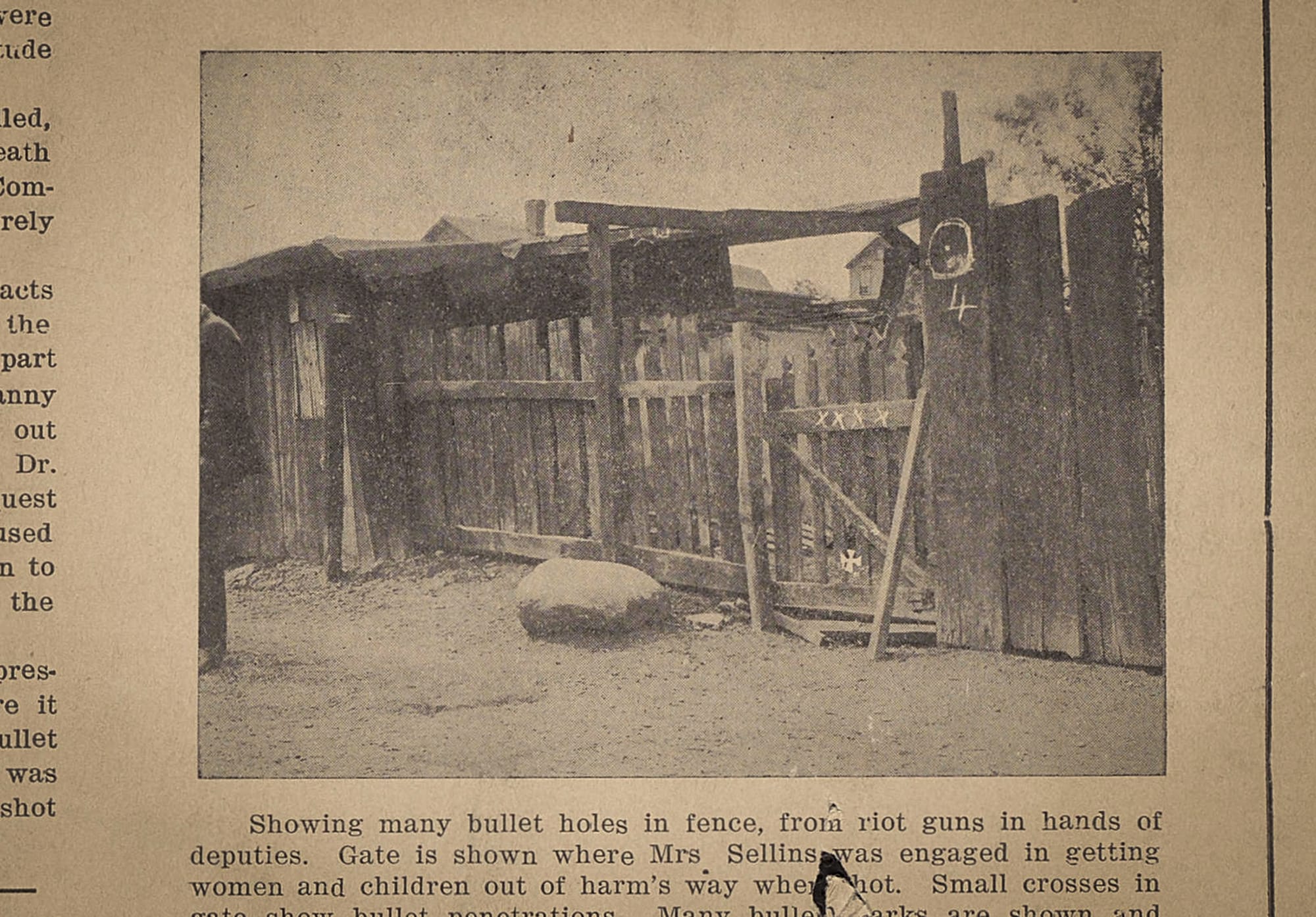
Around 4 p.m. the next day, Aug. 26, Sellins arrived in Natrona to persuade the few scabs working at the struck Allegheny Coal and Coke mine to join the union. On her way to the mine entrance, she stopped at a store that served as a local meeting place. There, several children told her they’d nearly been shot by a sheriff’s deputy discharging his firearm in an attempt to kill a few stray dogs and cats. One miner told Sellins he’d been beaten by sheriff’s deputies. Another said he was shot while fleeing. The bullet remained embedded in his shoe.
Sellins and the contingent of mostly women and children marched a short distance down a path to the mine entrance, which was guarded by sheriff’s deputies.
Sellins and the women and children approached a group of about six deputies lining the path. One witness said Sellins began chastising the deputies for firing their guns indiscriminately. They ignored her and used “abusive language," the witness said.
She’d apparently annoyed at least one of the deputies, who tried to kick Sellins. She dodged his blow but fell. She must have immediately sensed the danger she was in. Sellins rose to her feet and began to run. A deputy struck her twice in the face with a blackjack.
Then gunfire erupted. The women scattered. Sellins screamed for help.
Union organizer James Oates heard the gunfire and turned to see a deputy named Daniel J. Riley using a blackjack to bludgeon 54-year-old striking miner Joseph Strzelecki. When Strzelecki tried to flee, Riley shot him five times in the back. The bullets ripped through Strzelecki’s stomach, liver and intestines. He fell to one knee, then collapsed face down to the ground. Fellow striker Martin Symkowiak approached Strzelecki and rolled him over. The stricken miner was still alive and mumbled a few words, but Symkowiak couldn’t understand them.
Strzelecki’s life bled away. Symkowiak looked up. A deputy glared at him. “Get out, you son of a bitch,” the deputy said. “I’ll shoot you.”
A bullet whizzed past Symkowiak’s head. He fled.
Sellins lay face down in the dirt. A deputy had fired a bullet that struck Sellins' head with enough force to slam her body into a fence. Seven bullet holes marked the fence and buildings near where she fell. A young boy later saw Sellins’ false teeth lying on the bloody ground.
Moments later at least two witnesses reported seeing deputy Riley wearing Sellins’ hat and jeering, “I’m Miss Sellins now.” Riley would later contend that he merely put the hat on his head because both of his hands were occupied in carrying Sellins' body.
Deputies dragged Strzelecki by the shirt collar and heaved his corpse into an automobile. Then deputies, possibly including Riley, dragged Sellins' body by the feet and dumped it on top of Strzelecki’s body. All of the jostling knocked off one of Sellins’ laced shoes, which laid on the dirt road as deputies drove the bodies away.
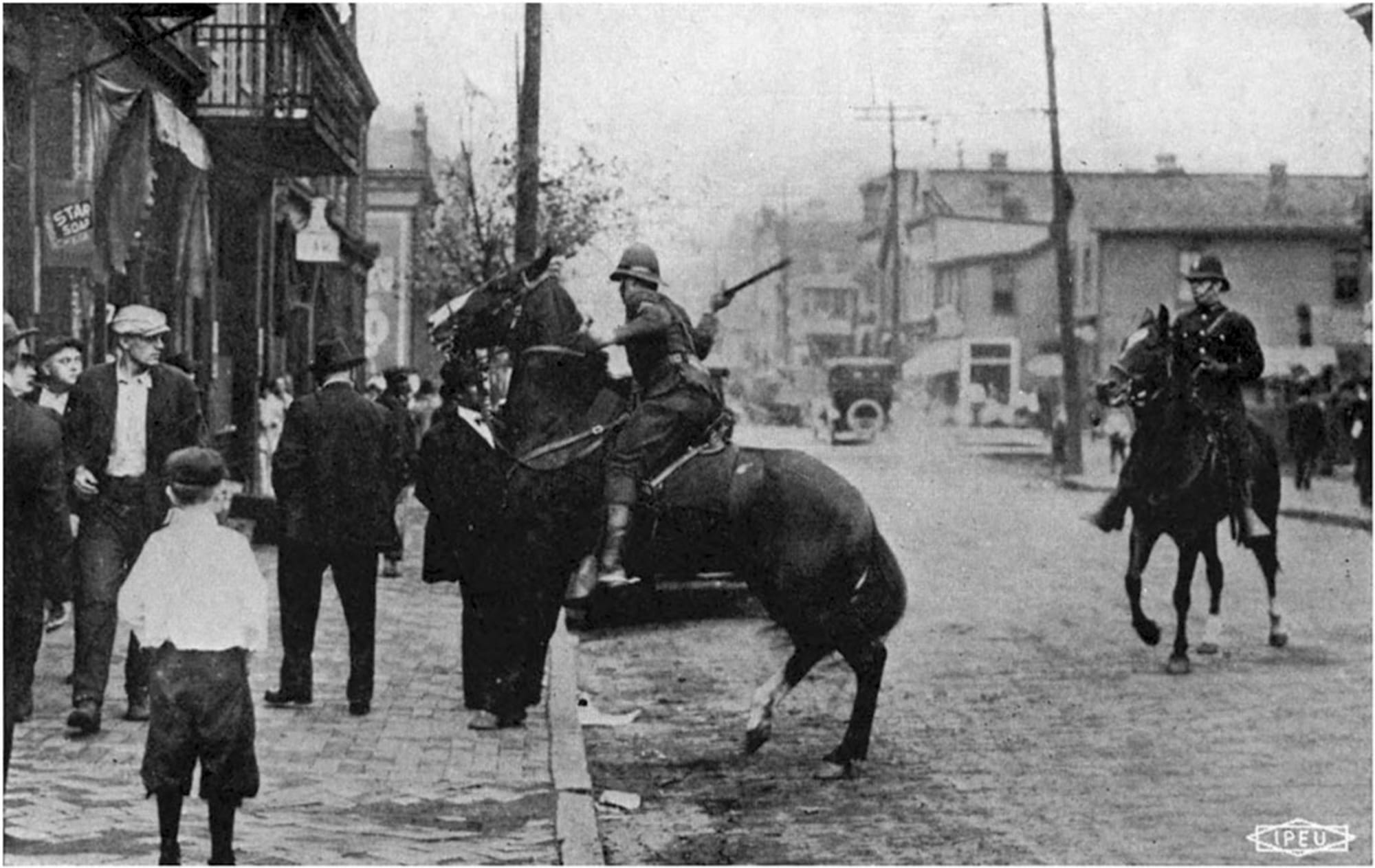
Two days later, on Aug. 28, striking streetcar workers in Pittsburgh once again gathered, this time to consider ending their 14-day strike in return for a six-cents an hour wage increase, a proposal they’d rejected on two other occasions.
The workers were in a tough spot. Leaders of the international union had declared their strike to be illegal and demanded that it end. If they continued with the strike, international vice president W.B. Fitzgerald warned, “then you are out of the amalgamated association.”
Several workers shouted out to condemn any talk of capitulation, but as the meeting wore on the objectors wavered. Their bid for higher wages had cost the workers $250,000 in wages (It had cost Pittsburgh Railways Co. an estimated $750,000). As a concession, the company agreed to reinstate strikers to their previous positions and honor an expired contract. At the meeting’s end, workers voted 2,082-408 to end the strike.
As the scabs departed car barns in the city, strikers demanded the facilities be fumigated before they entered.
Meantime, as August dragged on and steelworkers through the region geared up for what would be an historic strike, authorities ramped up their efforts to shut down any attempts to organize. In Homestead, Jones stood in the back of a vehicle to address workers and was quickly arrested. An angry crowd of Jones supporters gathered at the jail and threatened to take action, but Jones emerged from the borough building and convinced them to leave peacefully.
At a hearing the next day, a judge asked Jones if she’d secured a permit to speak at the rally. Jones replied yes, one issued by Patrick Henry, Thomas Jefferson and John Adams. Furious at Jones for equating union activity with patriotism, the judge hit her with a heavy fine.
The steel strike began on Sept. 22, with more than 250,000 workers walking out, shutting down mills from Pueblo, Colorado, to Chicago to Johnstown. Steel company managers were stunned. They greatly underestimated the workers' organizing success. The companies quickly regrouped and gained an advantage, however, by painting strike organizers as communists and revolutionaries, accusations that resonated in a country rattled by the Russian revolution a few years earlier.
Steel companies teamed with local authorities to harass and bully strikers. Police clubbed picketers, dragged striking workers from their homes and threw hundreds in jail. Managers hired tens of thousands of African Americans as strikebreakers, inflaming racists beliefs held by many white steelworkers and pitting desperate workers against each other.
In October, workers in Chicago gave in. They were followed in November by workers in Gary and Johnstown and Youngstown. The strike collapsed completely in the early days of 1920.
The strike may have been doomed shortly after it began. A stroke on Sept. 26 incapacitated President Woodrow Wilson, ensuring the federal government would sit on the sidelines. Without federal help, the striking workers were no match for the wealth of reserves and the power of the steel companies. In fact, federal support would not arrive until President Franklin Delano Roosevelt took office in the 1930s.
Jones stayed with the steelworkers, even as the strike effort flagged. She had a special connection with workers who understood little English. “What difference does it make what words she used,” wrote labor journalist Mary Heaton Vorse in "Men and Steel," her 1920 book. “They understood her anger. Her defiance and fearlessness they understood, too.”
Vorse once caught Jones pondering a picture of Sellins. Years earlier, the two were allies in the West Virginia coal fields. They’d faced the same threats, the same tactics of intimidation. In fact, a judge once admonished Sellins “not to emulate Mother Jones.”
Now, Sellins was dead, a martyr to industrial workers throughout the country. Her murderers would escape justice.
“Whenever I look at a picture of her,” Jones said, “I wonder it’s not me lying on the ground.”
SOURCES
Many of the details about Fannie Sellins’ final moments were found in Richard Gazarik’s book, "Black Valley: The Life and Death of Fannie Sellins," published by Saint Vincent College for Northern Appalachian Studies. Other sources include The Pittsburgh Press, the books “Mother Jones: The Most Dangerous Woman in America” by Elliott J. Gorn, “There is Power in a Union: The Epic Story of Labor in America” by Philip Dray, and "Men and Steel," by Mary Heaton Vorse; Allegheny County coroner’s reports, accessed through University of Pittsburgh/Archives Services Center; "Black Valley: Pennsylvania's Alle-Kiski and the Great Strike of 1919" by Carl I. Meyerhuber Jr., published in The Western Pennsylvania Historical Magazine in July 1979.