
Union nurses, lactation consultants at Magee struggle with staffing shortages amid contract battle with UPMC

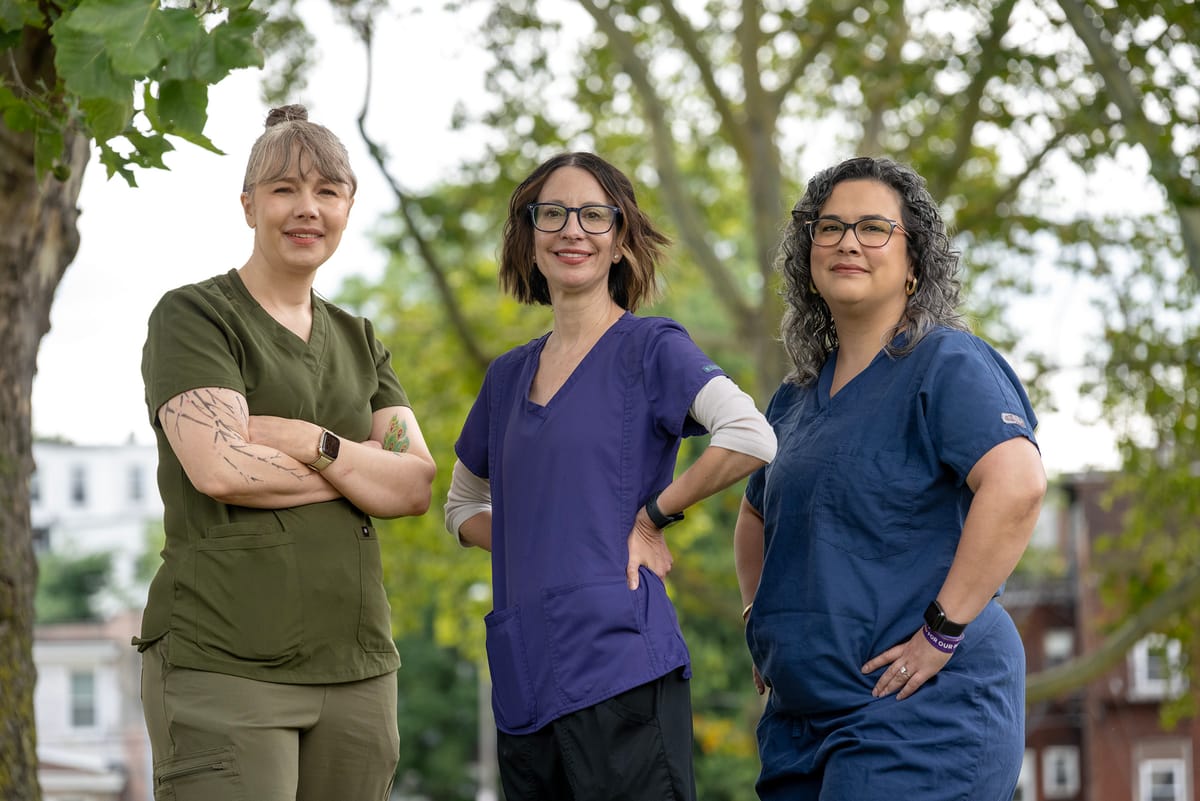
Delivering a baby can go as well as possible, said Liana Montes, and yet it can still be traumatic for someone giving birth.
That’s why the labor and delivery nurse at UPMC Magee-Women’s Hospital said it’s important for her to take time to explain the process and answer questions from her patients.
But because of what Montes and other healthcare professionals at Magee said was understaffing at the hospital, she doesn’t always have the opportunity to do that.
“Yesterday, it was me and one other nurse,” Montes said in a recent interview in Bloomfield. “I had a laboring patient, she had a laboring patient, then we had two other patients. We were just working side by side. I wasn’t able to help her take care of her patients, and I wasn’t able to fully care for my two patients the way that I would prefer.”
Montes is not the only worker at Magee to experience the struggle of keeping up with the needs of her patients, which became a major catalyst for the recent unionization by nurses at the Oakland hospital — the first such effort by nurses at a facility already owned by UPMC.
The motivation to organize was not simply about getting additional help, according to several workers involved in the union drive. It was about working to ensure that the hospital where more than 10,000 babies — or 45% of all births in Allegheny County — are born each year continues to provide quality care.
“It’s incredible to think about how better staffing would impact our whole community,” said Celia Emmons, a lactation consultant and union member at Magee. “Less women having traumatic births, feeling more supported. Women who are supported and finding more success in breastfeeding, and parents who are feeling more educated and prepared to take their premature baby home.”
Magee nurses voted in 2025 to form a union with SEIU Healthcare Pennsylvania and began contract bargaining with the multibillion-dollar healthcare giant in January. Negotiations have gone slowly.
While the nurses and UPMC may be close to an agreement on some small items, a wide gulf remains on staffing levels, they said.
The nurses are demanding that UPMC follow staffing standards set by the Association of Women’s Health, Obstetric and Neonatal Nurses, a Washington, D.C.-based nonprofit that provides highly regarded recommendations based on clinical research in women’s medicine.
“Since 2010, when the first edition of the AWHONN nurse staffing guidelines was published, there has been an extensive amount of nursing research disseminated about nurse staffing and patient outcomes, building on and supporting previous studies,” AWHONN said on its website. “There is strong and consistent evidence that inadequate nurse staffing has an adverse effect on inpatient hospital morbidity and mortality. The business case for adequate nurse staffing to meet the needs of the patient is robust.”
AWHONN standards, for example, call for a 1-1 ratio of nurses to a laboring patient receiving synthetic oxytocin for labor induction, a ratio of 1-2 or 1-3 nurses to newborns who require intermediate care, and 1-3 ratio of nurses to normal healthy birthing parent-baby couplets.
Lactation consultants see babies and patients giving birth after postpartum nurses, who, when possible, provide patients with initial education on breastfeeding. But Emmons said that postpartum nurses at Magee have to tend to as many as six parent-baby couplets at once and don’t have time to offer that information.
Because of that, Emmons said, she and other lactation consultants often need to start at “square one,” which is sometimes after a birthing parent has already bottle-fed a baby. That is, when they actually have the opportunity to see patients.
“We don’t get to see every breastfeeding family because there’s not enough lactation consultants.” Emmons said. “I would love to see more staffing so that we could see every family. They deserve the help and support to be able to feed their babies.”
When UPMC announced 200 layoffs, it also eliminated 300 open positions in June, according to Emmons.
“As part of the layoffs they just had, they also cut open positions, and they cut an open lactation position,” she said. “And the same week, they said they want us to start seeing every first-time mom — which I think is great — but we don’t have the staffing to do that. They basically asked for more and supported us less.”
Magee is the most profitable individual hospital in Pennsylvania and had an operating profit of $437.5 million in the 2025 fiscal year, according to Pennsylvania Health Care Cost Containment Council data.
Emmons worked briefly at West Penn Hospital in Bloomfield and remembered her manager saying, “‘If only we had the resources that UPMC has.’ But staffing was better, everything was better. After they unionized, [West Penn was] following AWHONN guidelines.”
Magee workers and their supporters in the community say they view UPMC’s hesitancy to implement national staffing standards as prioritizing profits over patients.
“We see it across the board in these vertically integrated healthcare systems such as UPMC — the emphasis on profit is going to trump patient safety and patient care in the end,” said Natalie Gentile, a physician who owns a practice in Shadyside and often refers patients to Magee.
That’s a concerning prospect for patients, Gentile said.
“As a physician, we have many, many patients assigned to us, and the nurses are the boots on the ground with those patients,” Gentile said. “If we don’t have them there advocating for patients, keeping an eye on changes that can happen rapidly, then we don’t have that communication line that’s going to keep patients safe.”
Amanda King, a registered nurse who has worked in the Magee NICU for about six years after a decade in labor and delivery at other hospitals, said she was driven by empowering women to have healthy pregnancies and deliveries.
But sometimes, she said, her job feels more like toiling in a factory than caring for patients in a hospital.
King likened her job to working what at times feels like an “assembly line.”
“You have maybe five minutes for [a baby] to wake up and feed them before you have to move on to the next baby,” she said. “You don’t get as much individualized care, paying attention to their cues, so they’re less likely to have a good feeding session.”
The effect on morale
While medical professionals at Magee said they worry that understaffing has impacted the overall quality of care at the hospital, it also takes a toll on worker morale.
“You’re going from grief to joy,” King said. “We’re pretty good at compartmentalizing, but over time, we’re exhausted and we’re drained. If we had proper time to process our own emotions, we can better help somebody else.”
Still, the stress nurses are under can be obvious to patients, some of whom voiced their support for the nurses’ efforts to ensure AHWONN staffing standards at a news conference on Tuesday organized by the SEIU.
Courtney Szigety of Ben Avon said she was grateful to the Magee nurses who helped her through her delivery when she had to be transferred to the hospital from another facility for medical reasons.
Throughout her labor and postpartum stage, she said, there were times when someone she had never met would enter her room or help her with something because her nurse was busy assisting another patient.
Szigety remembered a time when a fetal monitoring device wouldn’t stay on her baby’s heartbeat, and a nurse she did not know ran frantically into the room believing there was an emergency.
“I remember it really raised the tension of the room,” she said. “I was like ‘I have never met you. You seem really scared. Should I be scared?’ ”
In a statement, UPMC said, “Patients overwhelmingly report excellent care at UPMC Magee, reflecting the skill, dedication, and shared focus of our nurses, providers, staff and leaders on safe, high-quality care. We take patient feedback seriously and address concerns through established channels.
“SEIU choosing to stage a press conference does not change those processes or influence our approach to patient care. SEIU should focus on the bargaining table, where real progress is made. That is where UPMC Magee continues to work in good faith to protect excellent patient care and provide competitive wages and benefits for registered nurses and advanced practice providers.”
Another patient, Isabelle Cajka of New Alexandria also had to be transferred from another medical facility to Magee when she had her son, Hector, almost four years ago. The transition went smoothly, she said, thanks to the hospital’s caring staff.
She noticed, though, that the midwife who delivered her baby had a completely bloodshot right eye, apparently from the long hours and strain of the job.
It feels “exploitative” of the hospital staff, Cajka said, that UPMC makes huge profits while not following nationally recognized staffing standards when other hospitals in the region with fewer resources do.
And it’s concerning to her as a UPMC patient, she said.
“Are UPMC patients worth less than West Penn patients?”
This article originally published on July 27, 2026, at 8 a.m. EDT.