More than money: These queer-owned spots around Pittsburgh are building community
Owners foster safe, sober third spaces for customers with accessibility in mind
It’s a Saturday night, and the Nightshade Lounge in Dormont is hosting its grand opening. About a dozen people chat in the space filled with a mix of yellow-bulbed lamps, cozy furniture, eclectic decorations, art supplies and books. The space isn’t loud; it’s filled with the low hum of conversation, soft instrumental music and the scratch of colored pencils on paper.
It’s the atmosphere founder and owner Blake Nagel wanted to create when they decided to open a late-night sober spot for the queer community. They were inspired by the legendary Beehive Coffee Shop, which opened in February 1991 and was open 24 hours to a wide variety of creatives, eccentrics and community members for 28 years before closing in 2018.
“We built this because we were looking for a queer space in the South Hills, and we were having trouble finding that,” they said. “We miss the Beehive.” While Nagel wasn’t a regular patron of the Beehive, their longtime partner Jamie Cain was.
“My father worked down the street from there, and I was in there full time,” Cain said.
Nagel left their accounting job earlier this year to open the Nightshade Lounge, which happened over a whirlwind month before a soft launch on July 17 for friends and people who volunteered during the effort to get the space ready for its grand opening on July 18. Right now, the lounge, which operates as a 501(c)3, is being supported by Nagel’s savings as it gets off the ground.
Other queer-run businesses and organizations have been supportive, and nearby businesses in Dormont have also been receptive to the opening of the space, Cain and Nagel said.
“Meeting all the other local queer groups had a massive hand in getting this all together and help[ing] us navigate our first-time space has been huge,” said Cain, who also works at the lounge as a volunteer and was greeting people as they came inside, explaining everything the lounge has to offer.
The core mission and philosophy behind the Nightshade Lounge is accessibility and acceptance. The teas and snacks offered are listed at suggested donation prices; patrons don’t have to pay anything. In the back of the lounge is a free resource room where people can find a food pantry, clothing and accessories, and supplies for harm reduction, first aid and reproductive health supplied by the Autonomous Body Shop.
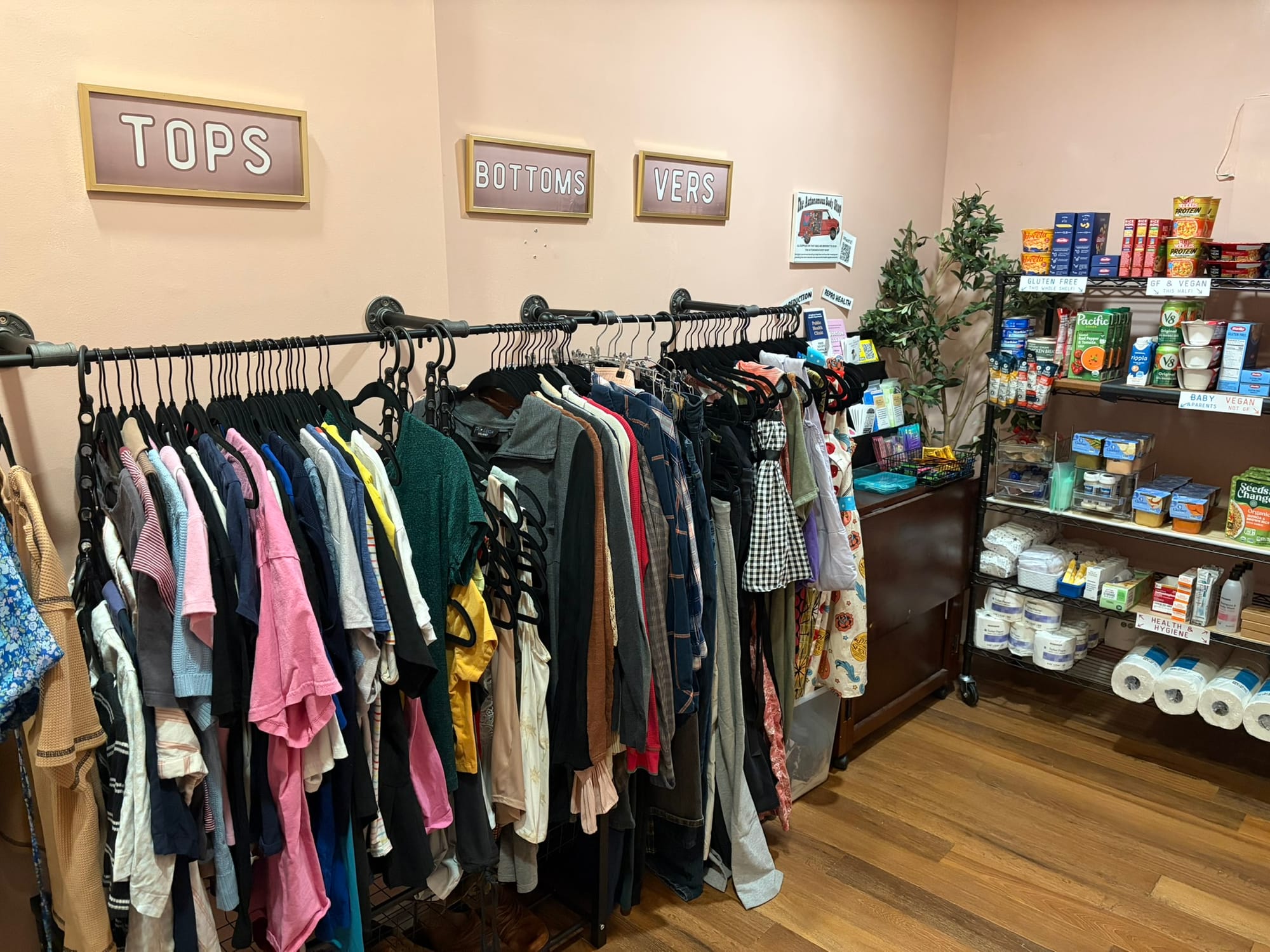
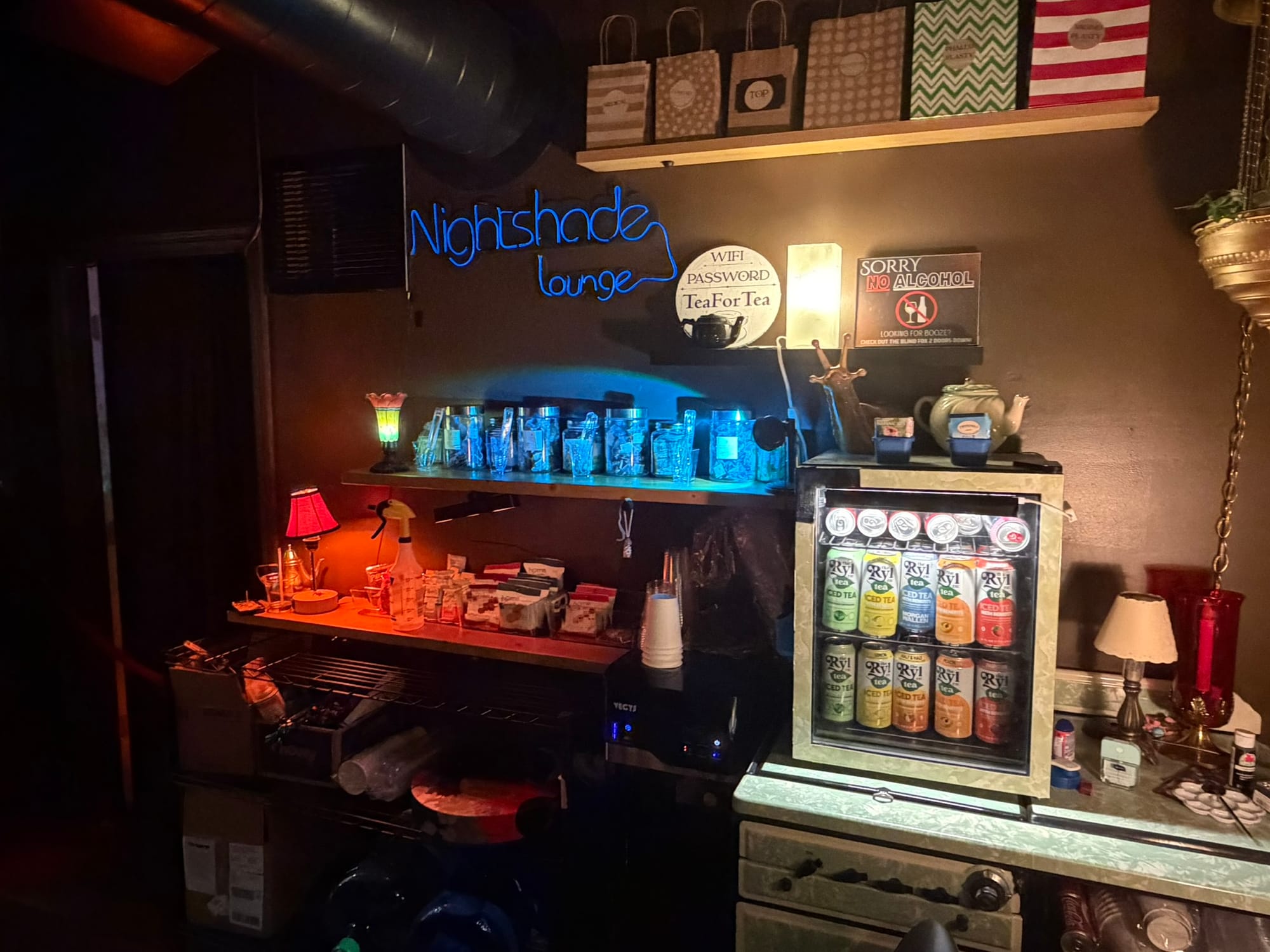
Left: The Nightshade Lounge in Dormont has a free clothes closet, food pantry and a collection of health supplies that patrons can utilize. A privacy curtain at the entrance to the resource closet allows patrons to try on the clothes before choosing which ones to take with them. Right: All the prices for the teas and snacks available at the Nightshade Lounge in Dormont are suggested donations — Patrons can have them for free as needed. (Natalie Duleba/Pittsburgh Progress)
Nightshade Lounge is the latest queer-owned sober establishment to open this year with a mission to foster community within the LGBTQ+ community and beyond.
Two more building community
The Soft Spot, Pittsburgh’s first and only sapphic cafe, opened in March in Garfield. Its owners, Aerin and Samm Adams-Fuchs, wanted to create a cozy, lived-in space where people could do work, relax and decompress.
When Aerin Adams-Fuchs was laid off by Meta last year, she wondered whether her dream of opening a sapphic space in retirement could be moved up to the present. She was ready to pour her efforts into something that would return them in kind and not get lost in the “corporate machine.”
The pair had been organizing shows, events and meetups for two years through the Pittsburgh Lesbiyinz queer social group and wanted to have a space to continue that work. After a series of pop-ups down the street and a delay in opening, The Soft Spot was born. While it is a business with coffee and food for sale, the couple wanted community as its true core.
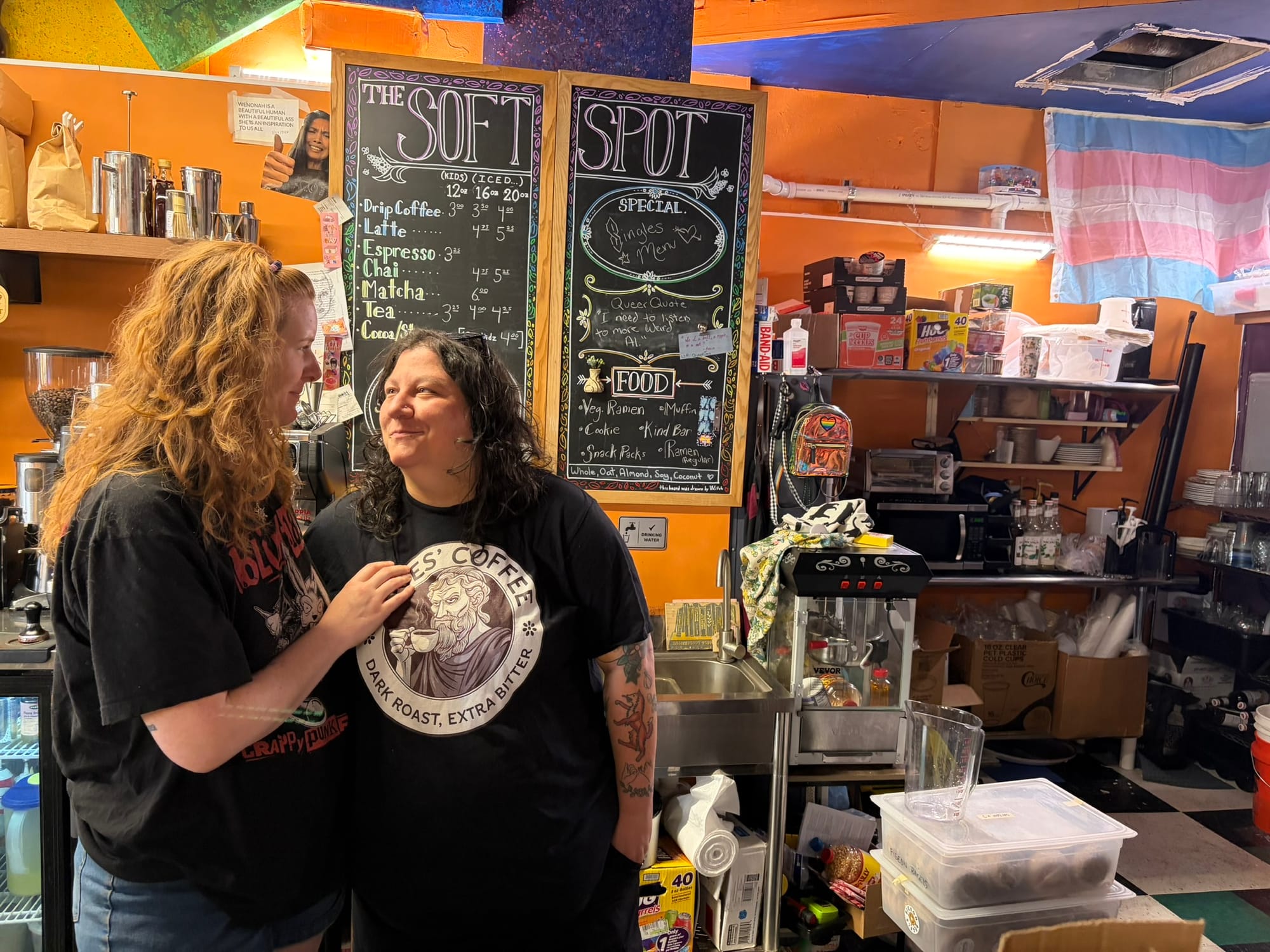
“Sometimes when I say it, I feel weird because I don’t think that people believe it, but if we didn’t have to run a business here and just have it be a community space, we would,” Samm Adams-Fuchs said.
Tiffy Overly, the owner of The Shelf Love Society, a romance-only bookstore in Lawrenceville that opened in April, expressed a similar sentiment.
“As much as I want people to come in and help me make sure we pay rent, I also want this to be a space that is just really welcoming,” Overly said.
As the two businesses have gotten off the ground, their owners have found that people are creating the community aspect as much as they are, sometimes even more so.
“There are very few events in our calendar that are constructed and ran by us fully,” Aerin Adams-Fuchs said. “Almost every single event on our calendar is a community member who walks in our door and says, ‘I want to teach crochet,’ ‘I’d like to have a Tarot night,’ ‘I want trans femmes who are in technology to have a night to meet up,’ ‘I want to meet up with my queer Jewish friends to celebrate a … holiday and do a clothing swap.’ ”
Samm Adams-Fuchs said she has been surprised by the niche communities that have hosted events.
“We just had an event last Saturday that I’ve never heard of before: It’s called a cup sleeve event, and it’s where people create cup sleeves to celebrate the birthdays of anime characters,” Samm Adams-Fuchs said. “This very sweet 17-year-old girl came in the first month we opened up, and she literally asked ‘Can I do a thing?’ … We finally had the event last weekend, and it was way more people than we would have ever thought that would have shown up for a thing like that.”
The decorated cardboard cup sleeves were left at the coffee shop, and the Adams-Fuchses gave them away to customers over the course of the following week, sharing the creativity with their customers.
At The Shelf Love Society, Overly said the Lawrenceville community has been very open and welcoming to the bookstore, and that it’s already gone beyond visiting just to buy books.
“I’m finding that people want to come in and just hang out, which is really cool,” Overly said. “And so we’ve been having people who buy blind dates [with a book] as a group, and then sit down on the couches and gush about it.
Building friendships and safe spaces
Overly said she opened the store not only to offer a wide variety of romance books across many identities and other bookish accessories but also to foster a third space within the bookish community.
“I think people are starved for third spaces,” she said. “Because you spend your time at work, you spend your time at home, and then, what else do you do?”
As described by The Third Space Collective on its website, third spaces are social environments that exist outside of the home (the first space) and the workplace (the second space). They are places where people can gather, socialize and engage with activities outside their normal routines. Third spaces can be anything from a cafe, like The Soft Spot and the Beehive, to libraries and bookstores, like The Shelf Love Society, to gyms, barbershops and more.
The Shelf Love Society hosts a weekly Silent Reading Club, a monthly in-house book club, a pen pal book club called Love, Annotated among other events like Stitch & Bitch, a bimonthly craft night, author signings and topic-focused gatherings like the Sapphics After Dark event in June.
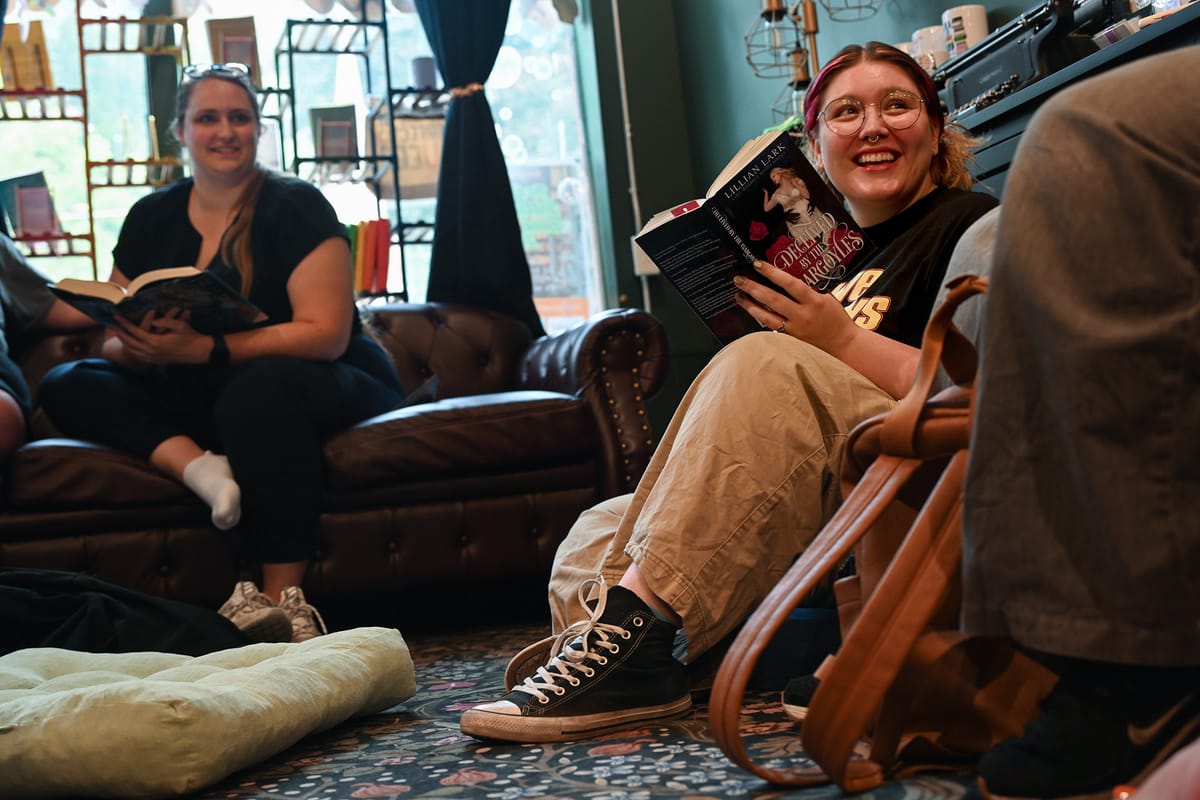
On July 16, the Silent Reading Club gathered after the bookstore had closed for business. Overly and her partner, Jewels Phraner, were set up on the couch at the front of the store talking as members arrived.
One member arrived, saying their best friend, another regular attendee, wouldn’t be coming because their cat needed to go to the emergency vet. Those already gathered were familiar with the cat’s health woes, as the Silent Reading Club has an active group chat. They can talk in between meetups and get to know each other beyond the confines of two hours each week.
“It’s leaving the store, which is really cool to me, because that says we're building this community,” Overly said. “Because while people are showing up here at the store to do things together, they’re also taking their friendships home and outside.”
The first hour of the club is the silent reading portion, with Phraner acting as one of two timekeepers — on July 15, the reading section started a little beyond 7 o’clock because conversation between the members was flowing naturally and abundantly.
“The timekeeper is a must,” Overly said. “Or we would just talk the whole time.”
The second hour has every member describing the plots of the books they brought and what star rating they’d give it. There is laughter, teasing and inside jokes bantered about, creating a boisterous atmosphere. Phraner’s book, “Mistakes Were Made” by Meryl Wilsner, is from the Love, Annotated pen pal book club, where members each buy a book and pass it among one another, adding their thoughts with tabs and sticky notes.
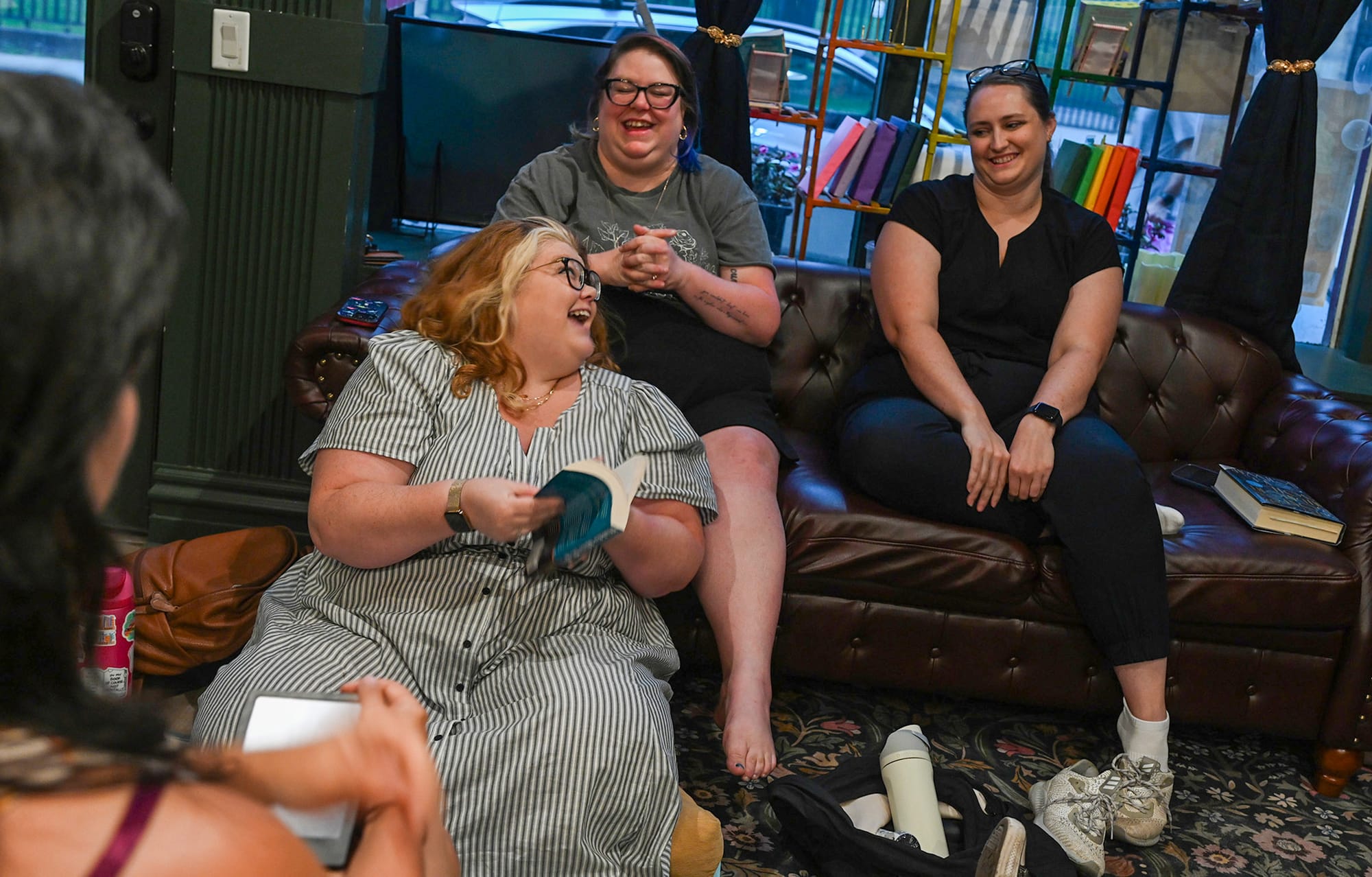
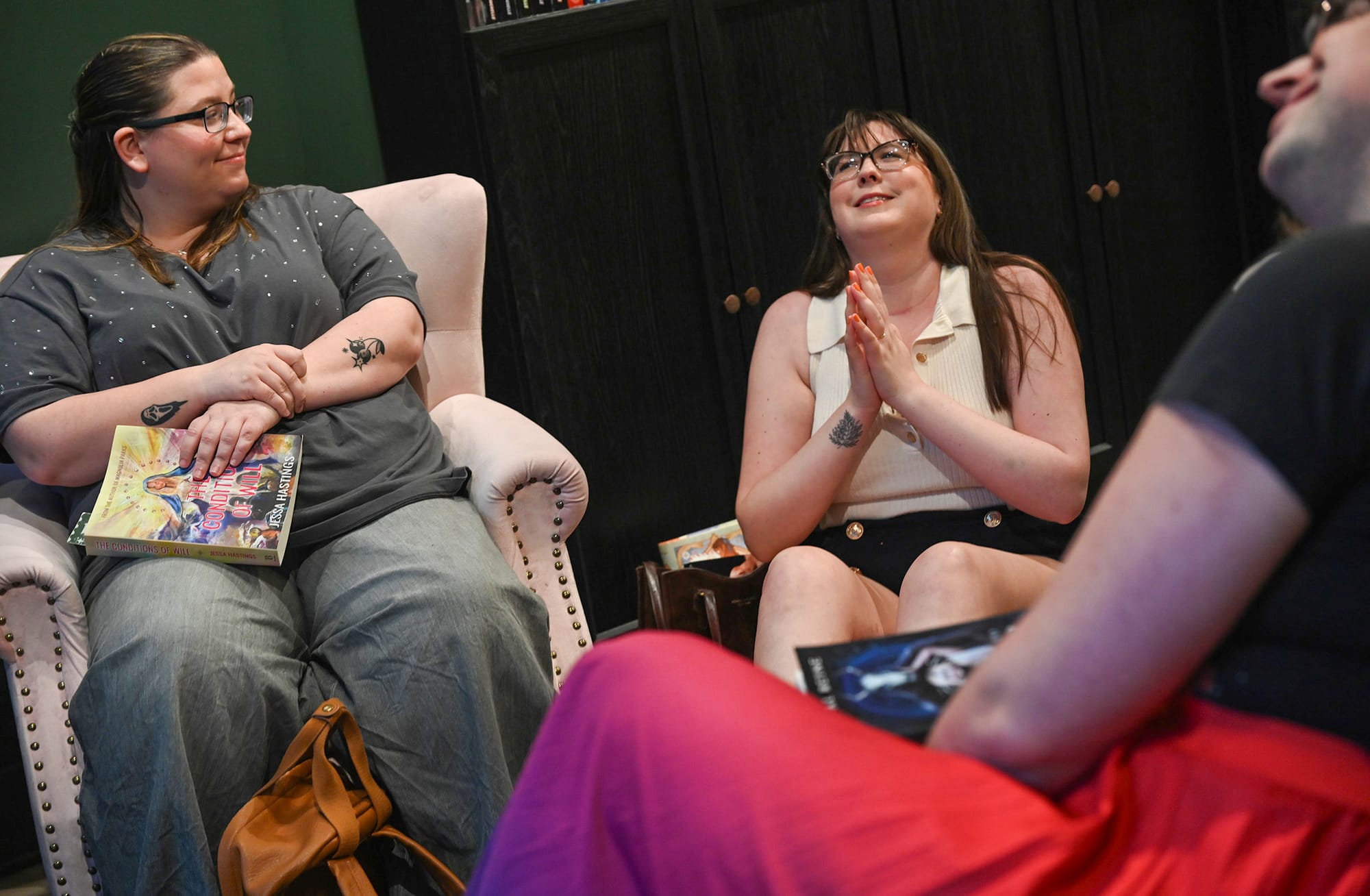
Left: The Shelf Love Society's "Silent Reading Club" becomes anything but silent when readers discuss the books they're reading. The Lawrenceville bookstore is often filled with laughter. From left, Jewels Phraner of Penn Hills, bookstore owner Tiffy Overly of Squirrel Hill, and Mathea Schafer of Penn Hills enjoy a light moment on July 16, 2026. Right: Brittany Kollinger, center, describes a plot twist while discussing a book she's read during the first hour of the club, as Nicole Czemerda of Bloomfield, left, listens. (Steve Mellon/Pittsburgh Progress)
Nicole Czemerda, who has been attending the Silent Reading Club since it started, said it’s her favorite thing to do.
“It’s just like meeting with friends,” she said. “Like I consider these friends now. As an adult, it’s harder to make friends now, and it’s just really nice. I look forward to it, and it forces me to read.”
That sentiment was echoed by Mev Howison, who became a regular attendee of the Silent Reading Club after her best friend told her to go.
“It’s obviously an amazing thing to do, but it’s also a built-in once-a-week hangout,” she said. “I would read anyway, but like reading with other people who love romance novels … just making friends as an adult is so hard, and this has made it so easy.”
At the Nightshade Lounge, Ollie Wiesenbach worked on painting a ceiling tile. Weisenbach helped get the lounge ready for opening and was given a ceiling tile to decorate as a thank you. Other patrons can do the same — a $25 donation for a quarter tile, $40 for a half tile and $80 for a full tile. Wiesenbach, who is friends with Nagel and Cain, said they planned on helping again and were looking forward to coming to Nightshade often.
“I wanted to be able to come to a space to be with my friends and meet new people,” they said. “It’s nice to get out of my apartment and do something. I like that it’s a space where I can make friends or just be around people. Even if we don’t talk, I think it’s nice to be around new people. I might come to an event or two, but I want to be creative. Maybe I start coloring and someone joins me, and there’s a new friend.”
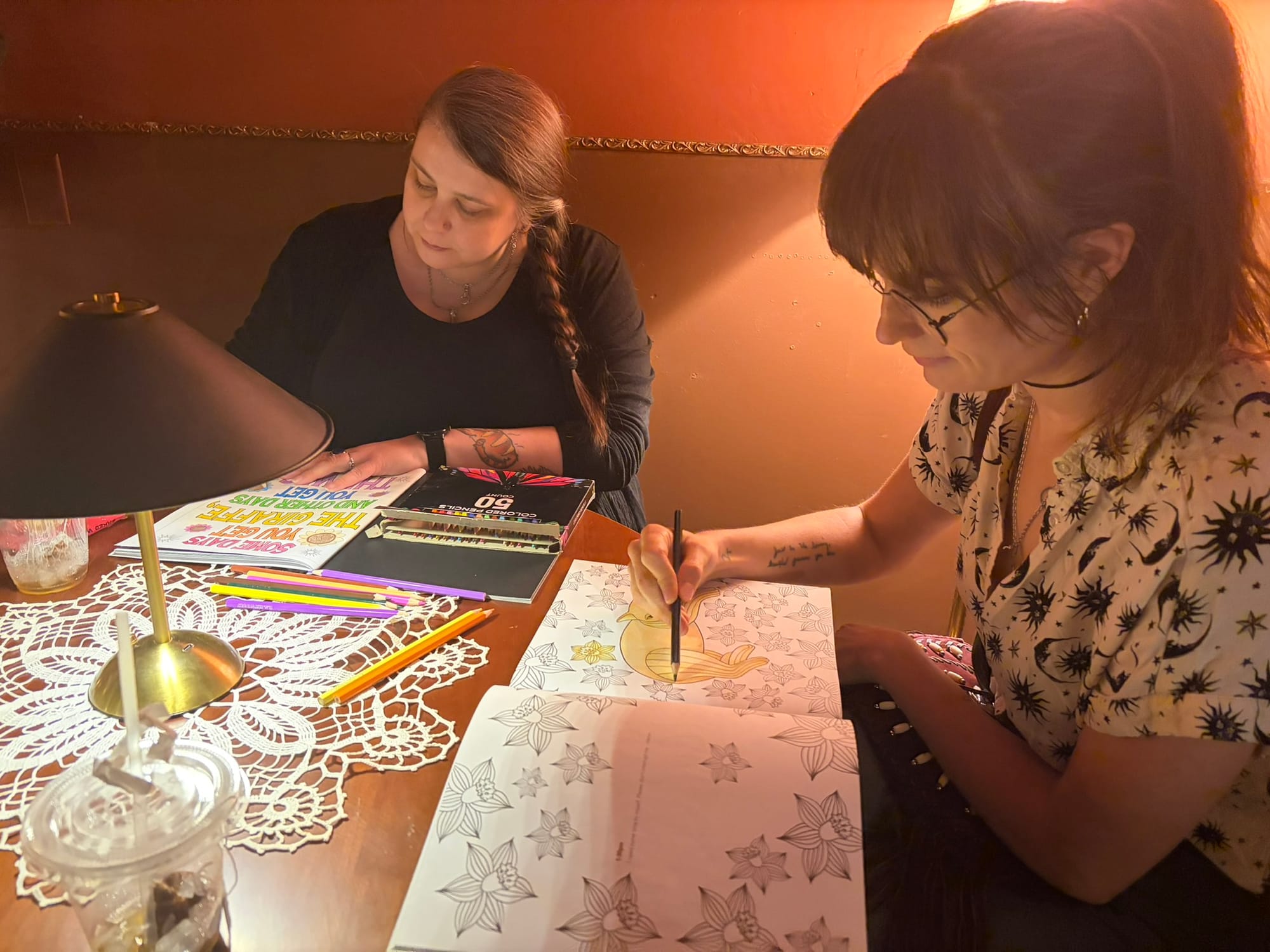
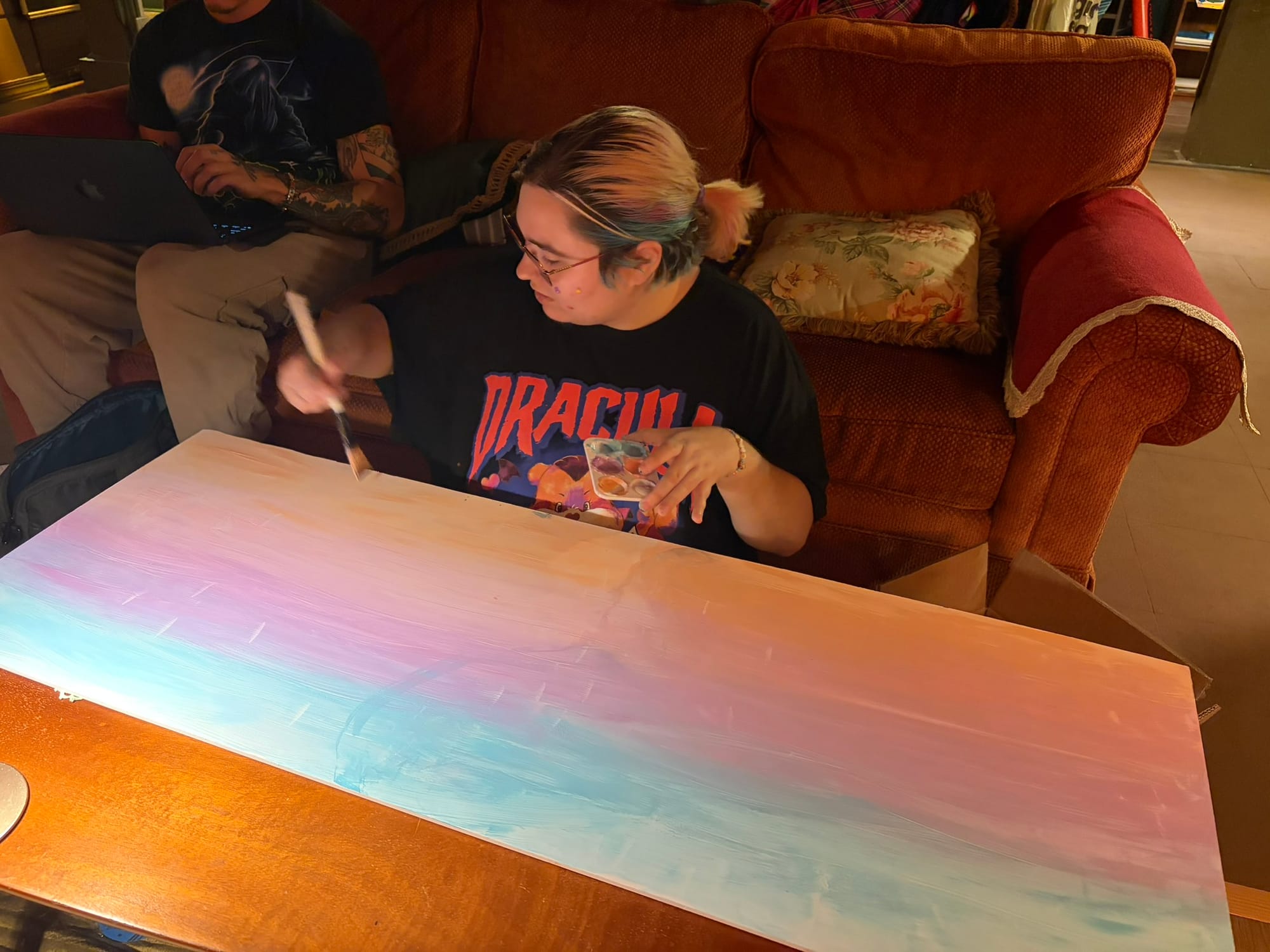
Left: Liz Gordon, left, invited her best friend of 16 years, Kalee Andres, to the grand opening of the Nightshade Lounge in Dormont on the night of July 18, 2026. The pair brought coloring books and chatted with one another in the calm, cozy atmosphere of the late-night sober queer space. Right: Ollie Wiesenbach paints the background of a ceiling tile at the Nightshade Lounge during the grand opening. Wiesenbach, a friend of the founder and owner, helped set up the space, and in exchange they and their best friend were given a ceiling tile to decorate however they wanted. (Natalie Duleba/Pittsburgh Progress)
Aimee Lebow, who owns The Crow’s Nest, a metaphysical store in Dormont, said that she wanted to do more than education when she took over the space from Well Oiled, an essential oil and apothecary shop that she was the manager of until the owner moved on from the space.
“I would say that it [Well Oiled] was kind of a community space, but it was focused more on education and that sort of thing — which we still do,” Lebow said. “But I really wanted to shift that into more community-centered … that was not just about learning, education. That was about sharing space and creating safe spaces and less about having necessarily a goal in mind.”
There’s a community room in the back of Lebow’s Dormont store where groups can meet. The Sapphics of South Hills social club meets there monthly. Those who have paid memberships to the store can also use the space for continuing education and use while also getting discounts on the supplies on offer.
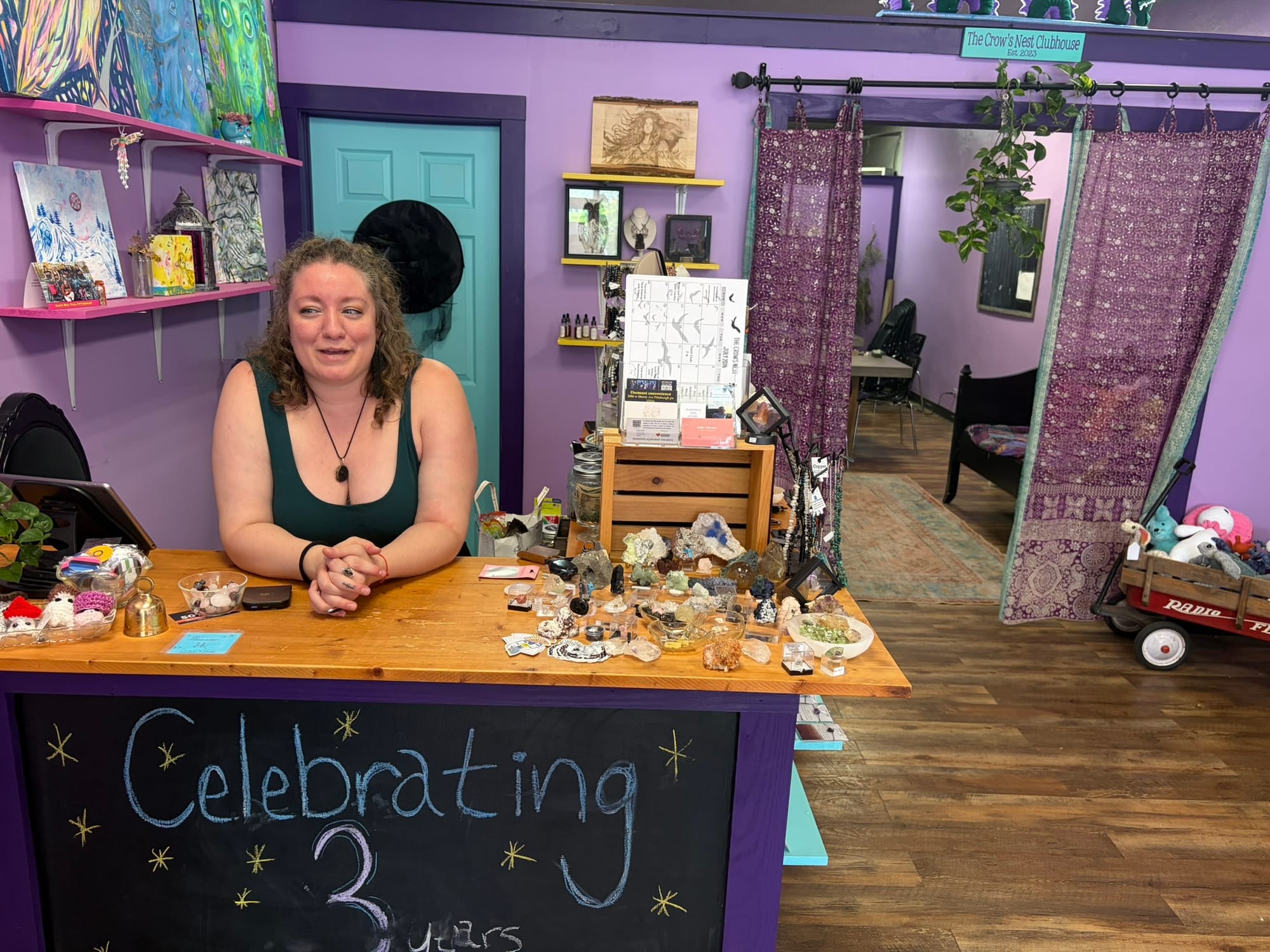
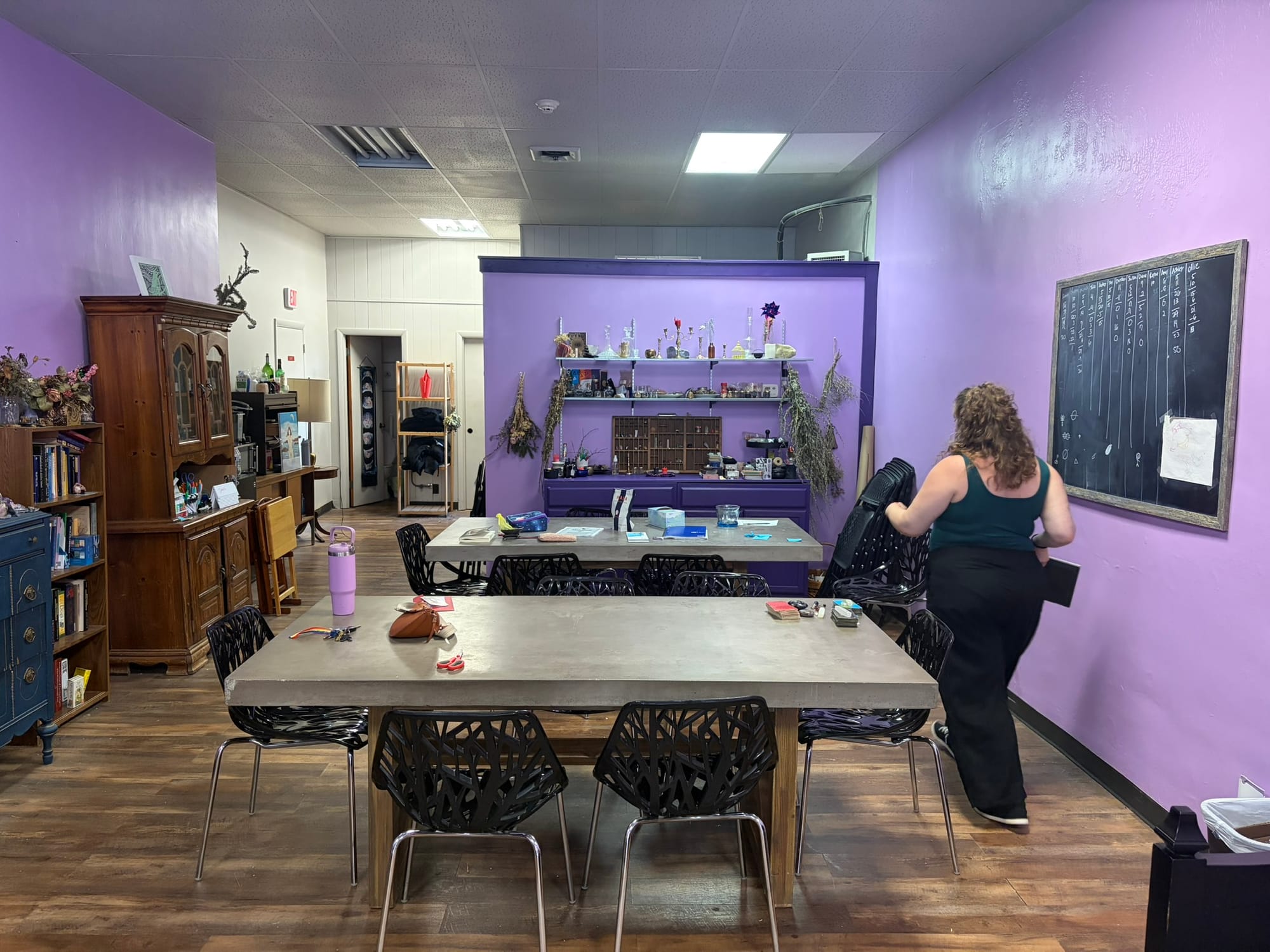
Left: The Crow's Nest owner Aimee Lebow, at left, doesn't charge LGBTQ+ groups to use the community room at the back of the store, at right, photographed on July 18, 2026. (Natalie Duleba/Pittsburgh Progress)
The Adams-Fuchses also said they want people to be able to come in and feel safe to unpack from a stressful day.
“You don’t have to be kiki-ing [being playful, talkative] at all times, or you don’t have to be your best self,” Aerin Adams-Fuchs said. “You can be an emptier side of yourself because being queer still sucks in a lot of ways; it’s still othered.”
She said that it can be tough for members of the queer community to exist in the current political atmosphere, and she wants The Soft Spot to be a place of comfort and support as much as it can.
Katie Dickey, who’s a regular at The Soft Spot, said having a place to process grief and trauma is important to the queer community.
“Where’s a space that on a long day you can slip in and kind of have all the grief and the hardship in a pretty place where people aren’t going to make you perk up about it and reach services in a space that doesn’t feel like a service center?” she asked. “People are often like, 'the crème de la crème of hard times is treatment programs, or interventions or monitoring people.' The secondary option is community space if you’re well enough for it. This space blends so much of who’s having a hard time, who’s doing well and really fortifies a web of people with different weaknesses and strengths that proves that structure [of traditional treatment programs] wrong, which is really cool.”
Offering a sober option
The owner of the Nightshade Lounge and their partner aren’t fully sober themselves, but they still wanted to find a space where alcohol wasn’t part of the experience.
“[S]omething that we were always looking for in Pittsburgh was a sober space. Just a low-key space to go at night that wasn’t a bar, and [we] couldn’t find,” they said. “So we said, ‘Screw it, we’ll make it ourselves.’ ”
Similarly, the Adams-Fuchses recognized that there weren’t a lot of sober options in the city for queer people.
“As nightlife organizers, we noticed a lack of space that was accessible to sober people and to people who are under 21. Some of our new best friends were under 21 and just didn’t have access to continuing building relationships, that, when they lost their families, were potentially life-saving relationships,” Aerin Adams-Fuchs said.
Aerin Adams-Fuchs said that originally she had looked into opening a bar or a diner-style establishment with a bar as a late-night evening space.
“And then a person we were talking to at the time and were potentially going to organize with was like, ‘What if it was sober?’ ” she said. “And the idea had just literally not occurred to us. That this could just not have any alcohol at all, and that changed everything.”
While the pair said there were people online who doubted whether they could sustain a business as just a cafe, the people they spoke to in person were consistently responding to having a non-alcoholic space.
Samm Adams-Fuchs is seven years sober, and Aerin Adams-Fuchs is not. But that doesn’t mean Aerin doesn’t recognize the importance of a sober space, she said. She said that originally she anticipated that there would be fewer people in the 21-35 age range at The Soft Spot because they already had bars to go to.
“But that’s not something that we’ve seen at all,” she said. “There’s value even for people who do love a gay bar. We can complement each other instead of replacing each other.”
“They can pregame here,” Samm Adams-Fuchs said.
Nagel at Nightshade said similarly that the bar a few doors down from the lounge, which is not a gay bar, was supportive of their sober space.
Link Copp-Millward, who was at Nightshade's grand opening, said he recognized the importance of having a sober space to gather at.
“It’s a really safe space where people can come and be themselves, and a place to come late at night without drinking and be a community, which is really important nowadays,” he said.
Dickey, who comes into the Soft Spot two to five times a week, said that she appreciated that it was a sober space.
“I don’t have a history with alcoholism or substance abuse, but I do have PTSD,” she said. “And I really enjoy being in a space where I can kind of reliably gauge what level of unpredictability it’s going to be. That level of sensory and safety control I think means a lot to folks who are struggling to be in community and feel like they’re fully present in community.”
Lowering barriers to access
While Nightshade Lounge operates as a nonprofit and doesn’t require any payment for any of its offerings, the other spaces operate as businesses. Even with that model, the owners make a concentrated effort to ensure the public doesn’t have to pay to be a part of the communities they’re fostering.
At The Shelf Love Society, the book clubs, meetups and author events have been free.
“That’s been really important to me because I don’t want monetary barriers to prevent people from thinking that they can come and benefit from what we’re doing,” Overly said.
At The Soft Spot, the Adams-Fuchses offer the space on their shelves and walls to artists for free.
“We don’t charge for them, and we hope every artist makes a million dollars from their art,” Aerin Adams-Fuchs said. According to The Soft Spot’s website, there are seven slots available to artists for two-month residencies.
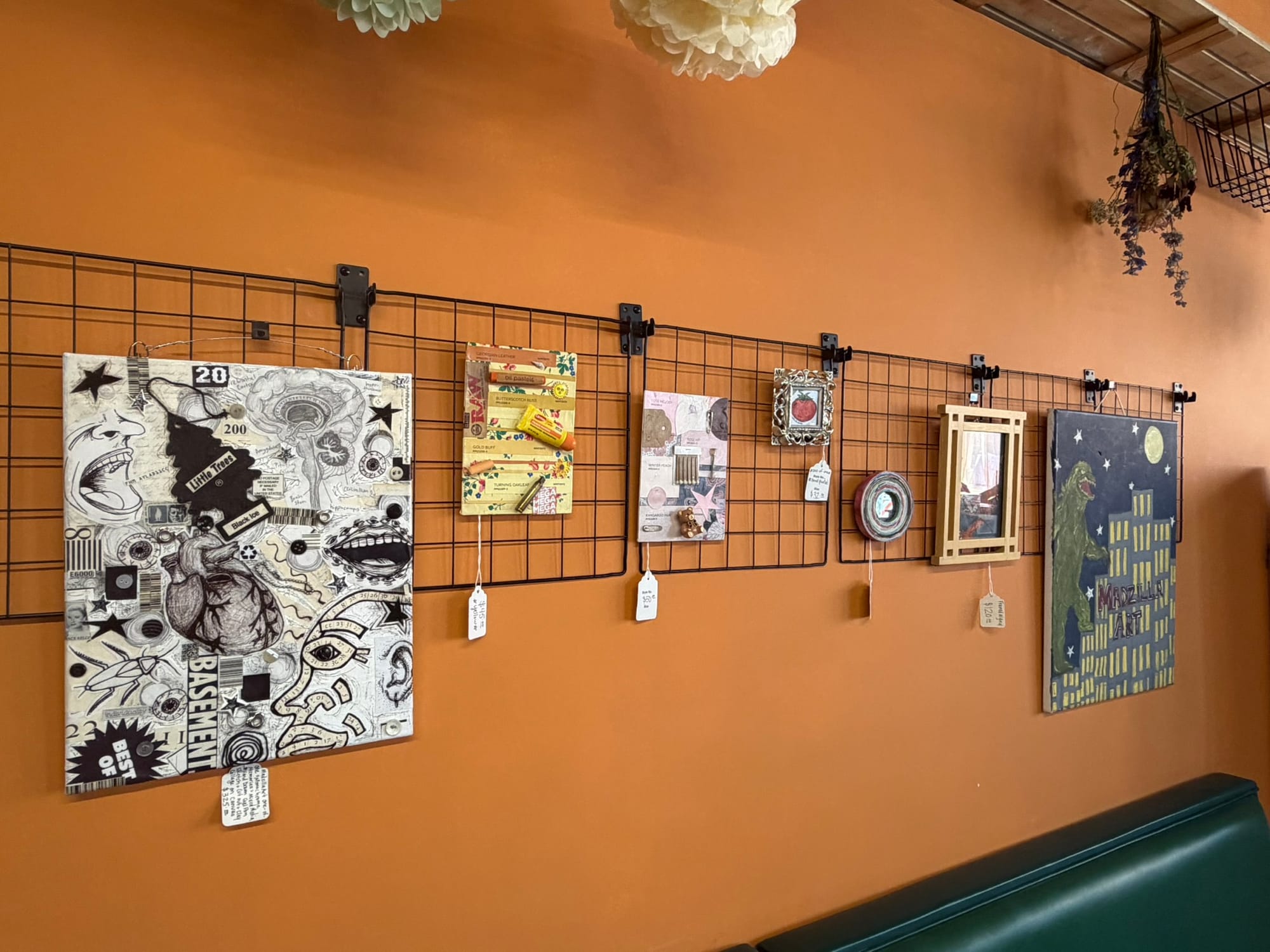
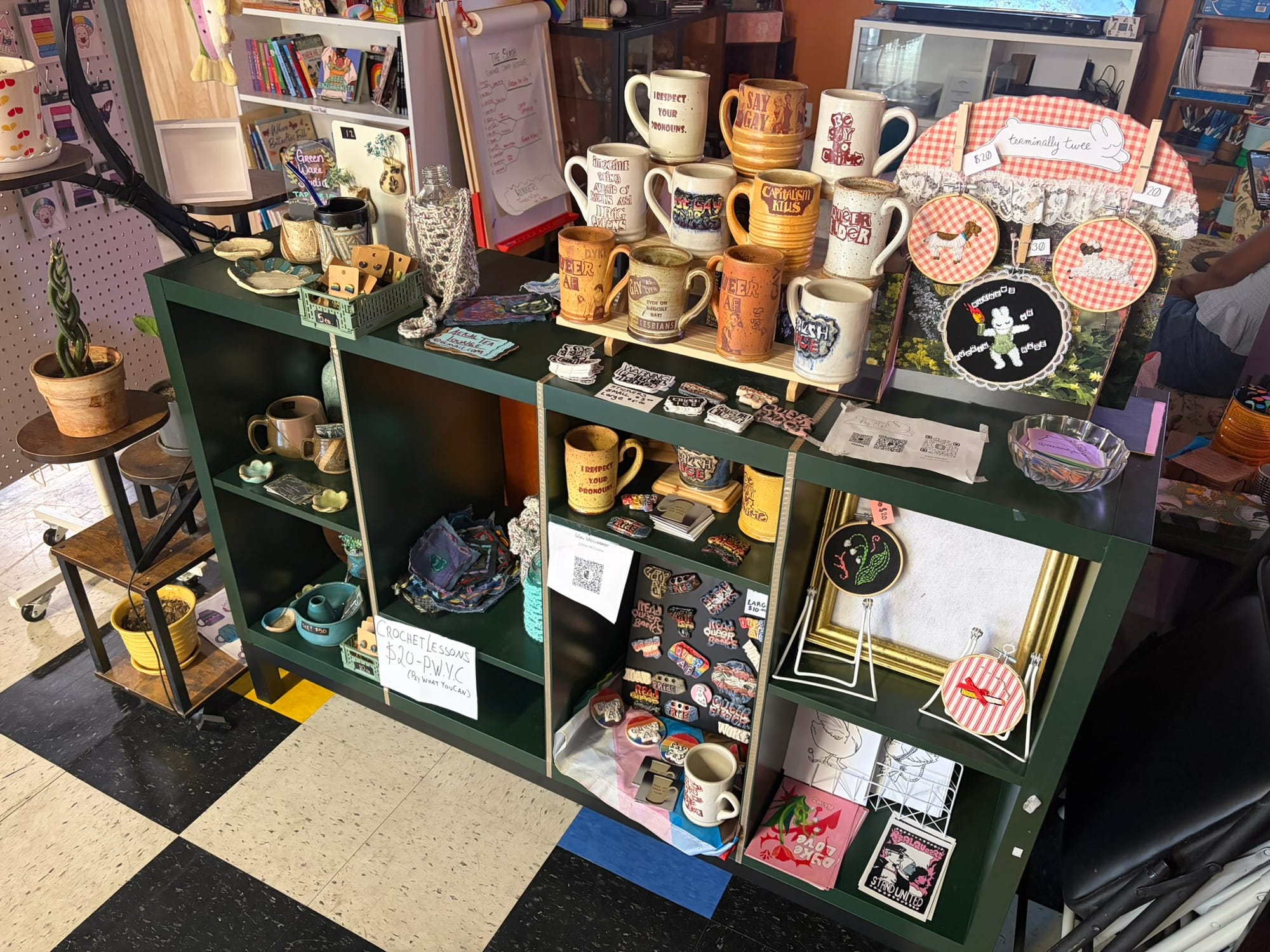
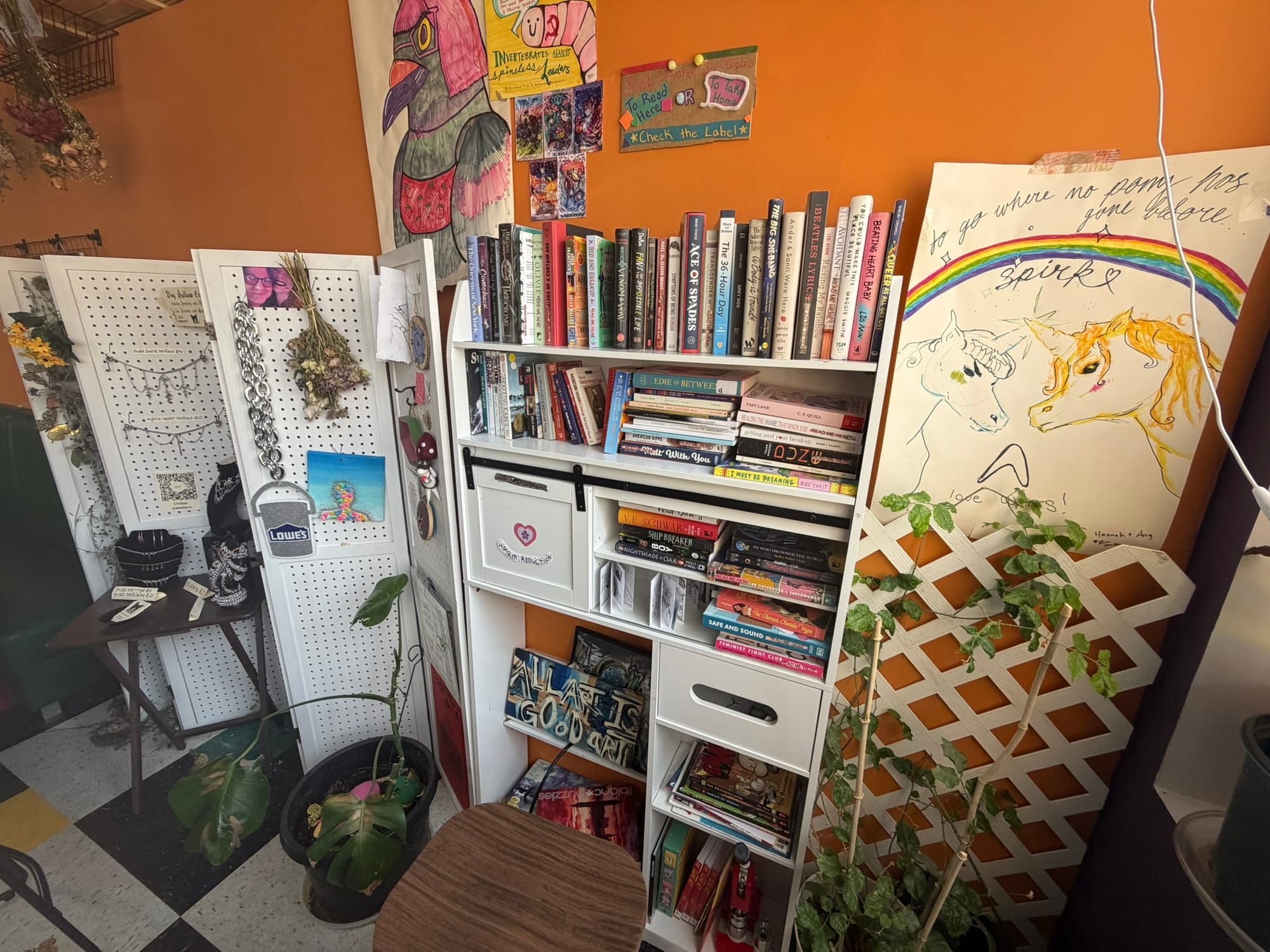
The Soft Spot in Garfield has areas around the store for artists to display and sell their wares; the owners don't charge any fees to use the spaces. There is also a little free library, at right on July 18, 2026, available to patrons. (Natalie Duleba/Pittsburgh Progress)
The cafe also doesn’t charge groups or individuals to use the space for meetups, craft nights or community events. Lebow, the owner of The Crow’s Nest, doesn’t charge LGBTQ+ groups for use of the community room at the back of the store.
Resources are also available for free at many of these businesses. The Nightshade Lounge has its resource room; The Soft Spot started with free diapers, wipes and hygiene products in the bathroom, and the offerings have grown since then through community donations.
“Within just a couple of weeks of being open, we had somebody bringing in Narcan, Plan B, COVID tests, safe drug testing kits and zines on use for injection drug users,” Aerin Adams-Fuchs said. “People were just like, ‘I know that people are going to need this.’ ”
Regulars have continued to give back to the space. Dickey spent an afternoon organizing the craft supplies. Another regular gave the Adams-Fuchses a ceramic mug they’d handmade with “I cried on the couch at The Soft Spot” pressed into the side. It’s stored on a shelf behind the counter.
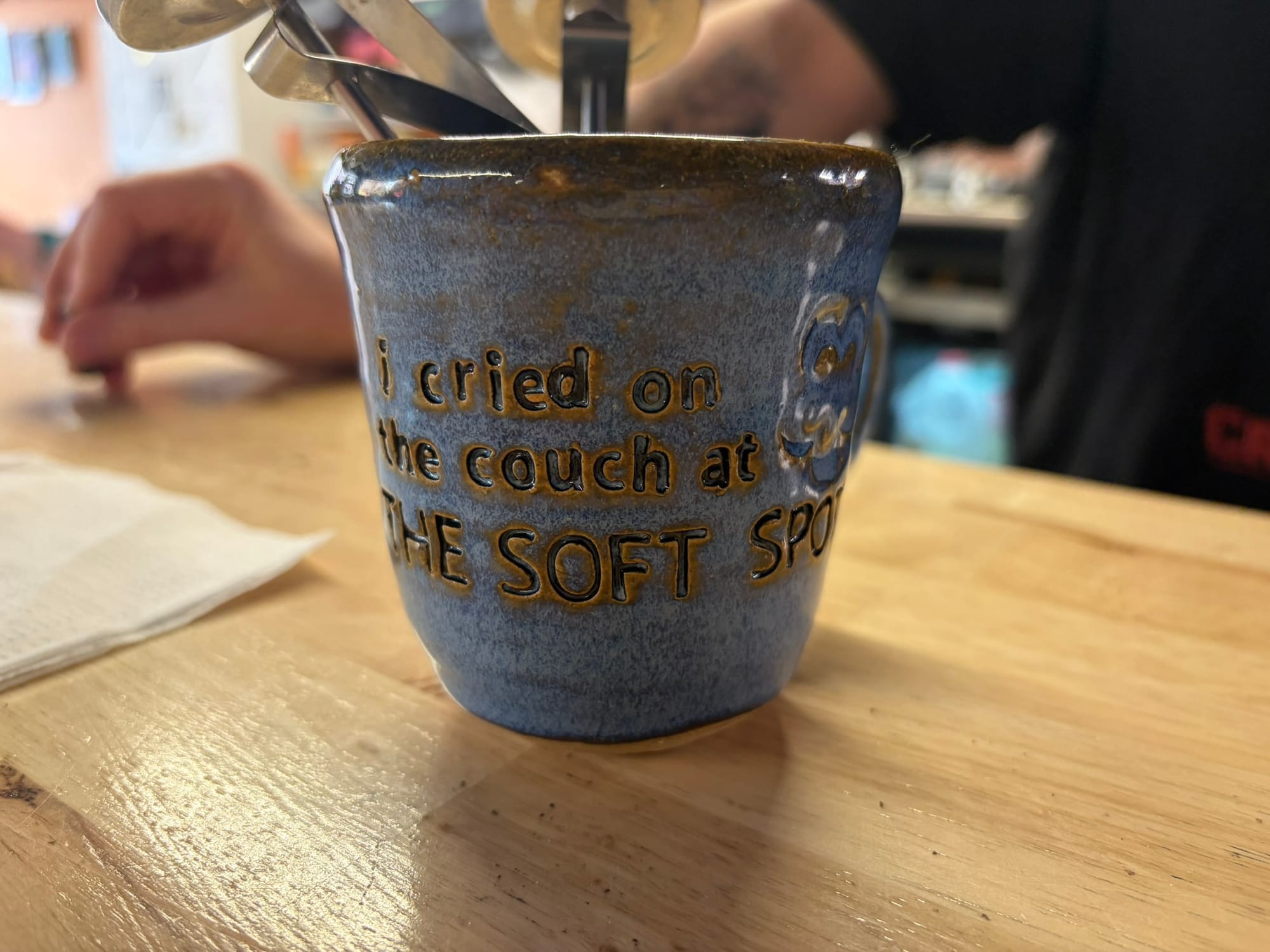
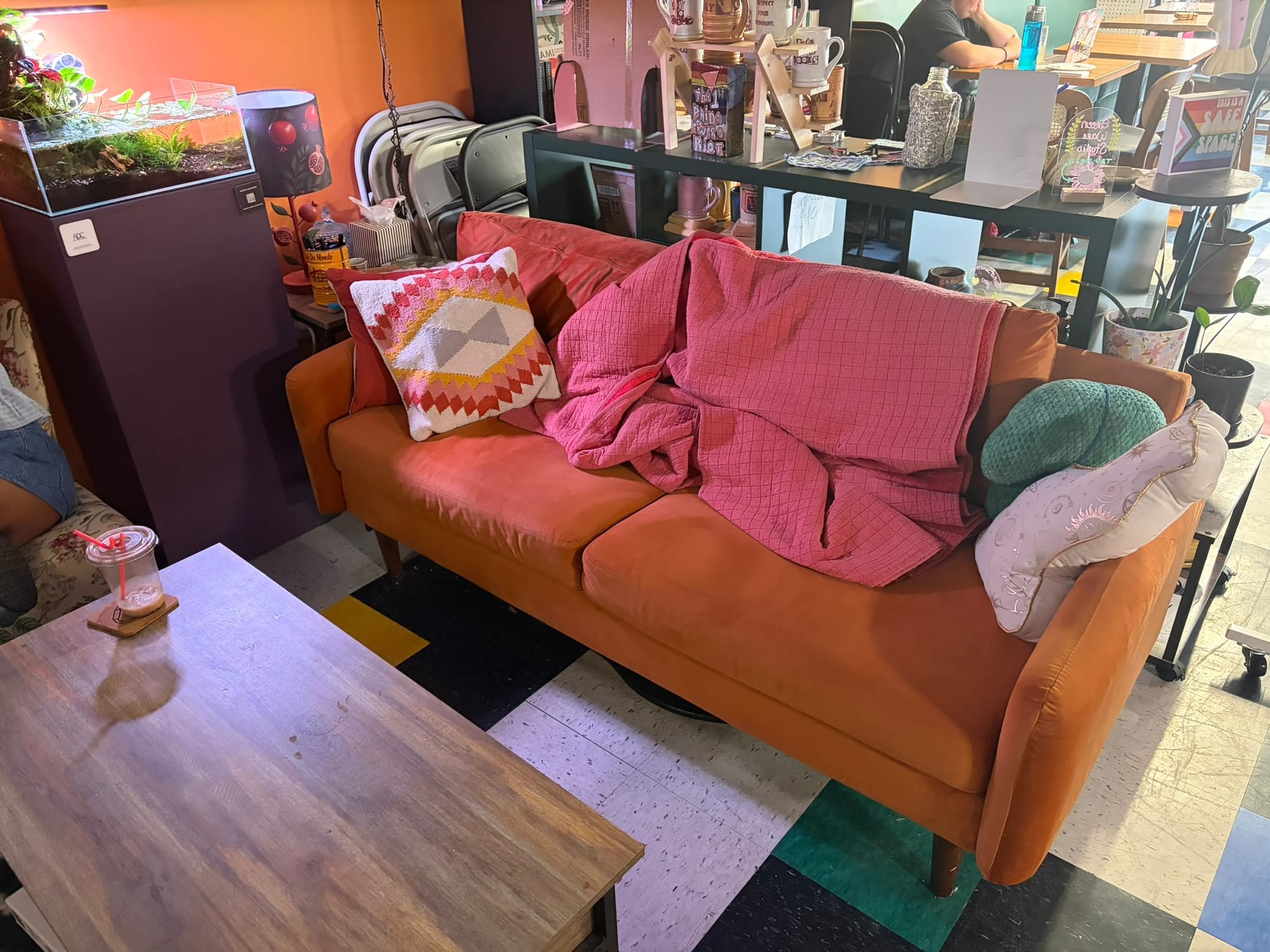
A regular made the mug, at left, and gave it to the owners of the sapphic cafe in Garfield. The couch nestled in the back of the cafe is seen at right on July 15, 2026. (Natalie Duleba/Pittsburgh Progress)
In smaller ways, the owners of these establishments have opened their doors to members of the community looking for assistance. Aerin Adams-Fuchs said that people come in to charge their electronics or get out of hot apartments into the air-conditioning at The Soft Spot.
At Nightshade, Cain said that while the lounge was under construction, people would approach and ask for work.
“We didn’t have anything to pay them, but we said, ‘Bring in this box, and you can have as much food as you want. Or you don’t have to do anything. You can just have the food,’ ” Cain said.
Looking to the future
Most of these spaces haven’t been open for long at all, but their owners said they hope to grow with the people they serve and interact with.
“We're just, we're hopeful that, like, when people think back on their experience in the space, they felt like they found what they needed here. But also that they felt like they could create here,” Aerin Adams-Fuchs said.
“I think the reason that we are succeeding this far is because we are continually asking the community what they want, and trying to continually work that in,” Samm Adams-Fuchs said.
At The Shelf Love Society, Overly said she wants to expand the variety of meetups at the store. She’s looking into holding a PowerPoint Night, where people can present on a topic of their choice, among other things.
“I think that as time goes on and get my feet more under me of the basic business aspects of it, then it’ll allow me more flexibility and time to do more of the community stuff,” she said. A regular member of the Love, Annotated asked to host their birthday party during the meetup, which Overly was happy to accommodate and believes she can do similar things for other people in the future. “The way we did it could be done for other people in the community. The space is small, but it’s very flexible — Everything in the middle of the store moves, and so we can have a big open area. We can set up tables and chairs.”
At The Crow’s Nest, owner Lebow wants to continue to create a space where people can explore their own spirituality and have more people engage with the community space.
“The point of this space is to — without religion, dogma or indoctrination — offer alternative spiritual paths and encourage people to find what those spiritual paths look like for them as individuals,” she said. “We need some rebellious, angry gays, girls and thems, and that’s what I’m here to facilitate that.”
At Nightshade, Nagel and Cain said the last touches on accessibility need to be completed — a permanent ramp to the front door and widening the door to the resource room to accommodate wheelchair users.
“I would like to see a good amount of foot traffic come in here; most importantly, I want to see people get what they need,” Cain said. “Eventually, a slightly larger space would be nice, but we also don’t want to depersonalize what we’re doing, either. We want this to feel like a community center where people can come in, relax, get to know each other and meet other people.”
The Nightshade Lounge, nightshadetea.org, 3019 W. Liberty Ave., Dormont, is open 8 p.m. to 1 a.m. Wednesday-Monday and closed Tuesday. The Shelf Love Society, www.theshelflovesociety.com, 4745 Butler St., Lawrenceville, is open 11 a.m. to 7 p.m. Wednesday-Friday, 10 a.m. to 7 p.m. Saturday-Sunday and closed Monday-Tuesday. The Soft Spot, www.thesoftspotpgh.com, 5407 Penn Ave., Garfield, has varied hours throughout the week and week-to-week but generally is open at 9 a.m. Monday-Saturday and closed Sunday. The Crow’s Nest, thecrowsnestpgh.com, 1414 Potomac Ave., Dormont, is open 12-7 p.m. Tuesday-Saturday and closed Sunday-Monday.
Editor’s note: The author of this article co-runs a queer romance book club in Pittsburgh, and The Soft Spot hosted the club’s anniversary party in April of this year.
This article originally published on July 27, 2026, at 8 a.m. EDT.