Five bullets, paralysis and the complicated act of forgiveness
In his new play, Leon Ford rejects the idea that we must chose between justice and reconciliation
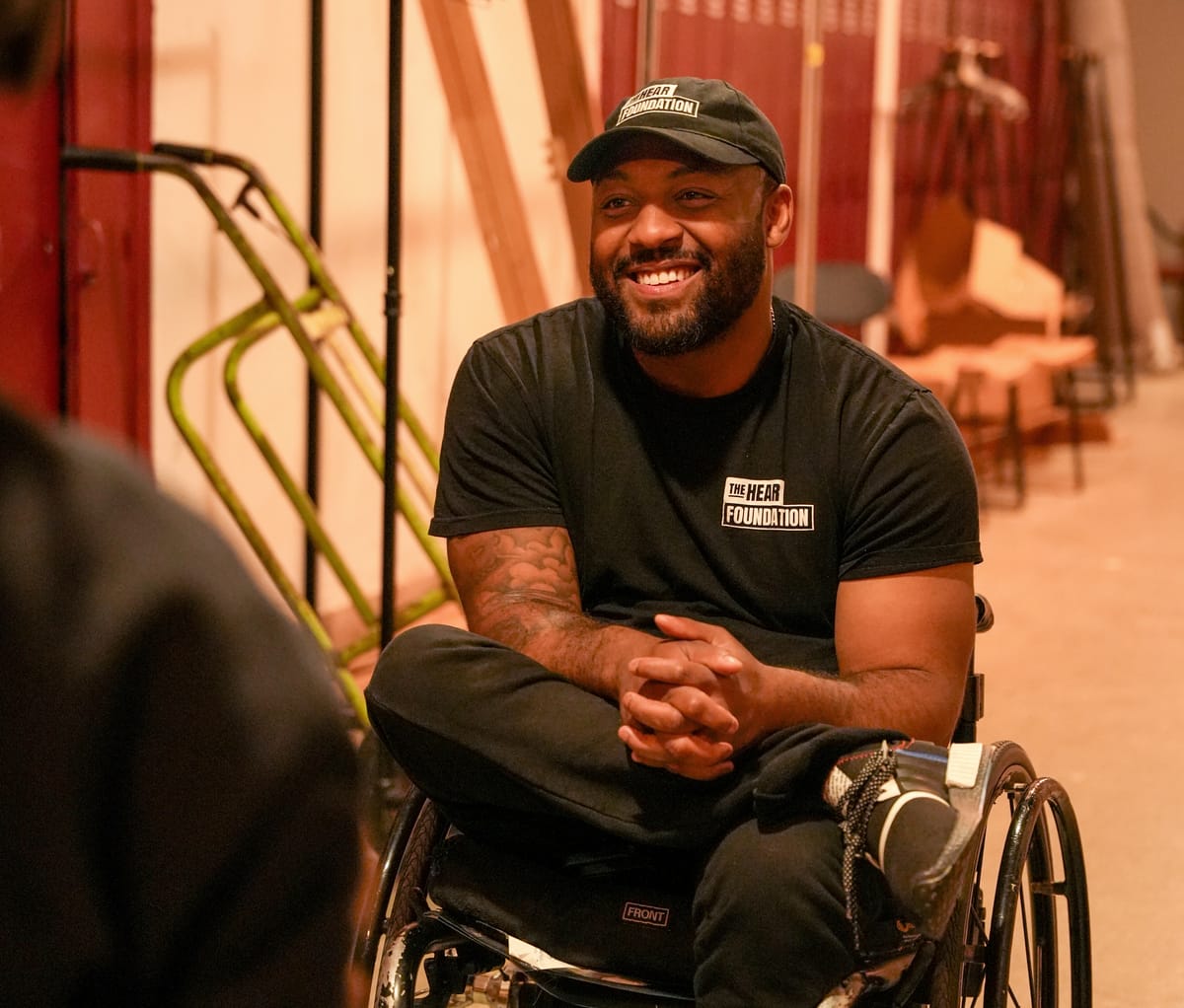
Editor’s note: Leon Ford was shot five times by Pittsburgh police in 2012 in a case of mistaken identity that left him paralyzed for life. In the years since, Ford, 33, of Irwin, has become a speaker, activist, author and, now, playwright. “The Weight of Forgiveness” will be presented at 7 p.m. Wednesday at the August Wilson African American Cultural Center. Here, Ford talks about his journey.
I have spent almost 14 years trying to understand what happened to me. Not just the five bullets. Not just the paralysis. Not just the traffic stop or everything that came after it.
I have been trying to understand what happens to human beings when their lives change in an instant. What are we supposed to do with the pain when the moment is over but the consequences are permanent?
For a long time, I thought forgiveness meant letting somebody off the hook. I thought it meant pretending something did not happen. Moving on before there was accountability. Making other people comfortable with something I still had to live with every day.
I know now that forgiveness is much more complicated than that.
I wrote “The Weight of Forgiveness" because I wanted to wrestle with that complexity in public. The play is based on a meeting that actually happened between me and the officer who shot me. But this is not a transcript of that meeting.
I took creative liberties because I wanted to go deeper than simply re-creating a conversation. I wanted to bring the audience into both of our worlds. I wanted to explore the families that raised us, the experiences that shaped us, the fears we carried, the institutions we learned to trust and the assumptions we had about people we did not know. Neither of us arrived at that traffic stop as a blank slate. We both brought our histories with us.
And after that night, we carried very different versions of the same moment.
The stage gave me an opportunity to explore that.
Some moments are dramatized. Some conversations are imagined. Some things are said onstage that may never have been said in that room where we met. But the questions underlying them are very real. I wanted the audience to feel the tension of sitting across from someone connected to the worst night of your life and trying to understand how he experienced it. Not to excuse the pain he caused but to understand it.
There is a difference.
Understanding someone’s perspective does not require surrendering your own. Seeing someone’s humanity does not erase his or her responsibility. And forgiveness does not make accountability disappear.
That is where “The Weight of Forgiveness” lives.
There are no easy heroes and villains in this story. There are human beings. People carrying fear. People carrying trauma. People carrying guilt, anger, assumptions, responsibility, love and regret.
And that truth is very uncomfortable – for me, for activists, advocates, family members, police officers, policy makers and the community at large.
We live in a time when we are constantly being asked to choose a side. Police or community. Accountability or forgiveness. Justice or reconciliation. Left or right. Victim or villain. I reject the idea that those are our only choices. I can believe that what happened to me was wrong and still recognize the humanity of the people involved.
I can forgive and still demand accountability.
I can love my city and challenge its institutions.
I can sit across from someone whose life experiences are completely different from mine and refuse to reduce him to the worst thing he has ever done. But none of that requires me to erase what happened.
The play asks questions I am still wrestling with myself.
What does accountability look like when punishment alone cannot repair what was broken?
What does forgiveness cost the person being asked to forgive?
Can reconciliation exist without truth?
What happens when two people experience the same moment and walk away with completely different understandings of what happened?
And maybe the hardest question: Can we see the humanity in someone without agreeing with them?
That question matters far beyond my story.
We are drowning in information and starving for understanding.
A video goes viral and within minutes we know who the hero is, who the villain is and what punishment should come next. We rarely ask what happened before the camera started recording. We rarely examine the institutions surrounding the moment. We rarely interrogate our own assumptions. We rarely consider that two things appearing to contradict one another might both contain truth.
That is dangerous.
Democracy requires more from us than choosing sides.
I want us to become a society capable of looking at evidence before reaching conclusions. A society that recognizes its own assumptions. A society that understands how institutions shape human behavior. A society willing to interrogate competing narratives instead of only searching for information that confirms what it already believes.
Most importantly, I want us to learn how to see one another again.
That does not mean ignoring injustice. It means having the courage to confront injustice without surrendering our humanity in the process.
My life could have easily become a story about hatred. There were moments when hatred would have made sense. But hatred would have required me to remain emotionally attached to the worst day of my life forever.
I could not give Nov. 11, 2012, that much power. So I chose something harder. I chose to heal. I chose to ask questions. I chose to sit at tables I never imagined sitting at. I chose to build relationships with people I once saw only as a uniform. I chose forgiveness not because what happened to me was acceptable, but because I refused to allow what happened to me to determine who I would become.
That journey eventually helped me create The HEAR Foundation. It helped shape my work around healing, equity, accountability and reconciliation. And now it has brought me to the stage.
I do not expect everyone who sees “The Weight of Forgiveness” to leave agreeing with me. In fact, I hope you don’t. I hope you wrestle with it. I hope there is a moment when you find yourself understanding someone you did not expect to understand. I hope you catch yourself making an assumption. I hope something you were certain about becomes a little more complicated. I hope you leave asking better questions. That’s because maybe reconciliation does not begin when we finally agree. Maybe it begins when we become curious enough to understand why we don’t.
And maybe forgiveness is not forgetting what happened. Maybe forgiveness is deciding that what happened will not have the final word.