Q&A: Anne Trubek of Belt Publishing on "American Made: Stories of Work from the WPA"

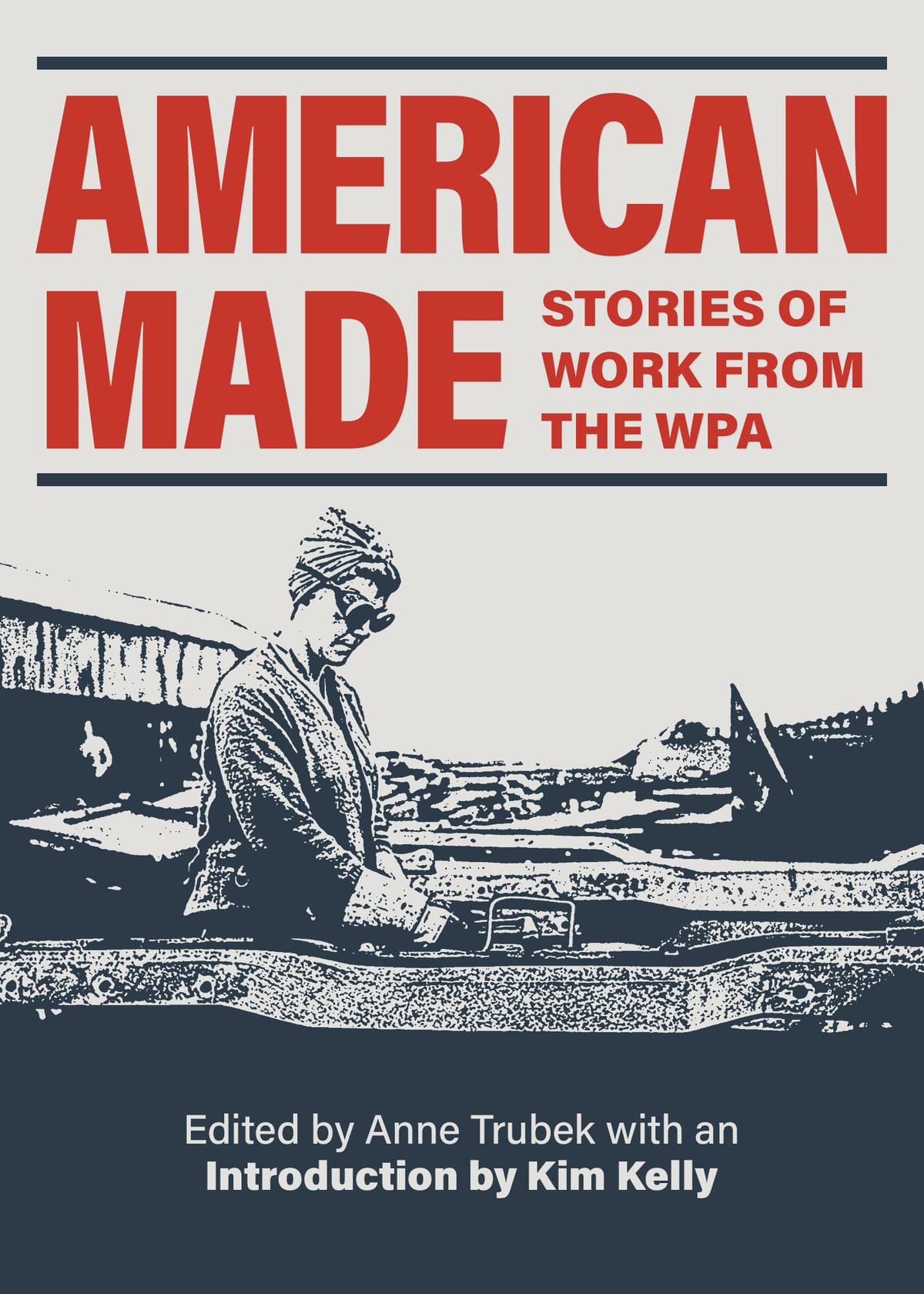
These questions were asked and answered during a recorded video interview that has been transcribed and edited for clarity.
Pittsburgh Progress: You write in the introduction about browsing the Library of Congress archives one afternoon and stumbling onto this American Life Histories collection. At what point did you realize that it was something that could be a book?
Anne Trubek: I just couldn't believe that there hadn't been more published from the collection, so I started researching. Even now, saying this to you, I'm still thinking that I must have missed something. I couldn't believe that there wasn't more out there. Once I realized that, I thought, "Well, I can help bring more of this out from behind the screen, as it were, from the archives. That's something I can do." I thought more people would probably be really interested in this material if they knew that it was there.
The Federal Writers' Project's American Guide Series is well known — not very well known, but more people know that those books exist. I've always toyed with reprinting one of those, but other people are doing that. The slave narratives are also more well known. I just realized that this collection hadn't been read and discovered by as many people as I thought, and that people would be interested in it if they knew about it. There was this wonderful woman, Ann Banks, who really was responsible for a lot of what we do know about it. I bought her book and studied it and went from there.
Progress: The archive calls these life histories, and they're supposed to be pretty comprehensive. But "American Made" explicitly centers work. Why did you think that would be the best use of these unpublished records?
Trubek: When I was reading all of this, there was all this discussion of onshoring manufacturing, bringing back these American jobs to factories, and people saying things like, "Well, look how great it was." Also, [Belt Publishing is] a press that focuses on the Rust Belt. The lived experience of these jobs felt like a gap in what's out there that I thought people would be interested in filling in.
Progress: Kim Kelly writes in the foreword that, understandably, she was most drawn to the union workers' stories. I was struck by the people who were working without a union at that point and how they survived. I'm curious how you view that dichotomy between a lot of these people being union workers interviewed in union halls, alongside people like the peddler who said he carried a department store on his back while he traveled from farm to farm in the Midwest.
Trubek: It's been interesting to me what people pull out of it. Kim thinks a lot about the union aspect. One of the early trade reviews really focused on diversity. So I definitely think people are getting out of it what they're bringing to it. As for the union stuff, obviously, this was the 1930s. It's a skewed sample because a lot of the interviews take place in union halls, so there's a huge amount of union activity.
What really struck me was how it's so rare to have people describe their working conditions, union or not. You don't have many records of that. To hear these people talk about what their daily lives are like, that was what really struck me — that kind of detail and specificity that really often just never gets recorded and remembered.
Progress: You write in the introduction that you chose interviews you felt would most resonate with people today. What did you look for to emphasize what modern-day readers would most connect with?
Trubek: I was really interested in jobs that don't exist in the same way anymore. There are still rubber workers, but we don't think about them. The textile workers, the fishermen. All these jobs still exist, but they're not thought about the way we usually think about working in a factory, right?
I wanted to get a snapshot of different ethnicities and the way the ethnicities and the jobs overlap. There's those French Canadian textile workers and the Vermont granite workers. I picked the ones that were interesting to read, whether it was because the person being interviewed had the gift of gab and was a great speaker, a storyteller, or because their job was so eye-opening. Like, the ironworkers saying, "Oh yeah, my buddy got killed last week trying to build the subway." You read that and you're like, "Ahh!"
Really, I'm hoping this is just a sampler and that it leads to more people looking deeper into the archive.
Progress: You spend a lot of time in the introduction writing about Benjamin Botkin and how he shaped this era of the Federal Writers' Project. What made him the figure that you most wanted readers to meet?
Trubek: He's just amazing. He was a folklorist, and when he is starting to do folklore in the '30s, it's only seen in terms of tall tales and legends. And I think today even we think of folklore that way, but folklore can be so much more than that. It can be the everyday lives of Americans, and he wanted to broaden that. A lot of what he trained the worker-slash-writer-slash-interviewers to do are sort of what modern interviewing techniques are as well and ethnographic techniques.
He was really smart and sensitive, and he saw what he was doing as offering the utmost respect to the people whose lives he was documenting. He got in a lot of trouble politically, and that really hurt his career, but he was fine with it. The HUAC hearings and the way that the program was shut down became political in much the same way that the NEA and the NEH are seen as political today. So there's all these resonances.
It's like the best kind of unsung hero. He did so much and was so important and influential, but he was not looking to make the project about him. He had really smart, complex approaches to what he was doing that he saw would have ends that I think were the right ends. He thought that if more people understood these lives and had access to these lives, everything else would be richer. I just love him.
Progress: You write in the book that Botkin viewed immigrants as distinct "components of a 'composite America' " rather than people who should be blending into a dominant culture. You mentioned earlier how ethnic identity was, in this period especially, tied to workplace and neighborhood, which describes how a lot of Rust Belt cities are still organized. Pittsburgh is known for having that distinct neighborhood culture, and people often cite that at the top of reasons why they love it here. What do you think readers in cities like Pittsburgh could get from stories like this?
Trubek: Pittsburgh's identity is based on work, right? It's the Steel City with the Steelers. It's very unique that way. But then you also have these different ethnicities that were working in similar fields. This sort of lets you see how it's always been that way. There's always this sort of way that immigration patterns and work patterns follow each other. We see this today, too, in certain lines of work.
I think that connection of immigration and workplace has, in some ways, been preserved here more than other cities, just because — and this is for the Rust Belt generally — there's not as much economy that's come since. So it's sort of just stayed preserved, like an archaeologist dusting off the little warrens. I think people will see that and recognize perhaps some of their family history if they're from Pittsburgh.
Progress: You frame the book within a specific political and cultural moment, where many people are expressing nostalgia for how Americans used to work. There's also been this surge in political rhetoric that argues new immigrants are taking jobs away from "real" Americans. What did you hope that these voices could say back to that?
Trubek: Well, that the work sucked for the most part, and that working conditions were brutal. Money was terrible. Also, these jobs are still being done by immigrants today. The people who did those jobs in the '30s, if they were from Irish enclaves, Italian enclaves — to make a complete overgeneralization — probably became more middle class, middle management, moved away from that kind of blue-collar labor. But there are plenty of people doing it now. As I say, it's the same story with different flags.
We could do another project today where we would go and interview blue-collar workers, workers in unsteady, non-unionized pink-collar jobs, and you would probably find many of the same stories and many of the same immigration patterns and many of the same ethnic patterns. If we were to do it today, it would just be different demographics. And also, yeah, [to highlight] the false nostalgia of these jobs.
Progress: So many immigrant workers in this book name themselves and describe exactly what they did to get to the United States. They gave their life stories to somebody on the federal payroll at the time. I cannot imagine immigrants having that sort of candor with any government employee today. What do you think that says about what kind of record this is? If somebody were to try to do work like this today, what might be lost?
Trubek: Well, I think a lot of people wouldn't agree to it, right? A lot of people would not agree to these kinds of interviews because if you're trying to sort of do a similar type of person or profile today, they're likely not officially working here — in a way that was not a problem for those people in the '30s. So yeah, you couldn't do it. I don't even think — even if you're a journalist instead of a federal employee, they wouldn't do it. So this was a time when immigration was wanted, and we wanted certain kinds of immigration for sure, and so not as many people had those worries about being deported if someone found out they were at the meatpacking plant.
Progress: Why do you think this specific Federal Writers' Project collection has seemingly gotten less attention over the years?
Trubek: I don't know. I do find it a mystery, and there are a lot of historians and scholars who study the WPA and the Federal Writers' Project, but this particular part of it seems to be less researched. I'm kind of hoping that, in response to this book, I'll understand better why that is.
Progress: How does it feel for you to publish a book born from a program that was ultimately defunded because it was targeted for allegedly being politically radical, and then watch the same thing play out now with massive federal funding cuts for arts, humanities and culture initiatives?
Trubek: It's horrible. What's happened in the last couple of years is devastating and extreme, but it's also been part of a pattern that's been happening for a long time. I'm not young, so it's not new to me to see cuts to the arts and humanities and culture. It's been my whole life, but it's devastating. I think people are even forgetting it's an option that the federal government or state governments or municipal governments can support artists and art and culture and the collection of history. I think it's important to remember that yes, actually, this is an option. Lots of places do this. I mean, Canada has extraordinary funding for such programs. So just a couple miles from us, you can find a lot of support for such programs.
I eavesdrop on and participate in lots of conversations about how we fund these things, and everyone's like, "Well, you need the rich person, or you need the worker collaborative" — all these options. Also, it could be the government. We have to remember that is a function of many governments, and America's never been at the forefront of that. The WPA was an aberrant and wonderful moment in our history where we really doubled down on that, and it's had extraordinary impacts, and we have to just keep remembering it and hoping that there could be a moment where it becomes possible again.
And it also could happen on the municipal level. Pittsburgh could have funds. There are other cities in the country that do that, and they really have a disproportionate impact on the communities when they do invest that way, and it's relatively cheap compared to lots of other things that municipalities can do. So I do think that that part is important. And thanks for asking that because even I'm forgetting about that.
Progress: A lot of people are now realizing that the federal government isn't going to be reliable for the foreseeable future to fund those things. It's forcing a lot of people who craft words for a living to reconsider how we do the work. You started an independent publishing house yourself. Considering the political climate — and especially in the age of AI — do you feel writers have a particular responsibility right now?
Trubek: I would say it's tough to be a writer right now. It's tough to be a writer whose goal isn't to get the biggest check, publish the bestseller. I think that it would be important for people to understand that there are other routes to go that are meaningful and have wider cultural impact. That's the thing that I'd like to see more of — a little less chasing of the brass ring.
I think that individuals can make their own choices. I think that it would be wonderful if there were more opportunities, easier ways for people who are inclined to do certain kinds of work to see that it is possible and to see options. We are living in a time — and this isn't just when it comes to writing or media, and this isn't really only about the most recent administration; this has been going on for a long time — you just have this diminishing sense of possibility.
And so rather than put it on writers, who are trying to figure it out, I'd put it on those of us who have the capacity to show what other kinds of pathways and opportunities might be there for people, while being very realistic about what they might have to give up.
Progress: In the introduction, you call "American Made" your "ironic contribution to America250." How else would you describe this birthday present to our country?
Trubek: I'd say that there are some pretty kick-ass Americans in this book. They were struggling against really tough odds, and had really difficult lives, and they are absolutely worthy of celebrating.
This article originally published on July 27, 2026, at 8 a.m. EDT.